
On this page
Advantage normally means drawing two attack modifiers and applying the better one; disadvantage means applying the worse one. They do not mean adding a third card to your normal draw. Original Gloomhaven’s rolling modifiers add another branch to the procedure, and Jaws uses a different rule when an advantage comparison is ambiguous.
This guide covers original Gloomhaven (first edition) and Jaws of the Lion with its standard decks. Do not use it as a second-edition, Frosthaven, or digital house-rule guide.
Choose the procedure for your game
| Question | Original Gloomhaven | Jaws of the Lion |
|---|---|---|
| Advantage, without rolling cards | Draw two; apply the better | Draw two; apply the better |
| Disadvantage, without rolling cards | Draw two; apply the worse | Draw two; apply the worse |
| Advantage comparison is ambiguous | Apply the first card drawn | Choose the card you prefer |
| Disadvantage comparison is ambiguous | Apply the first card drawn | Apply the first card drawn |
| Rolling modifiers | Use the branches below | Not part of the standard Jaws decks |
A rolling modifier has the rolling-arrow symbol. A card with an added condition or element is not automatically rolling. Check the symbol, not whether the card has extra text.
Advantage and disadvantage cancel, without counting sources
Strengthen supplies advantage; Muddle supplies disadvantage. A ranged attack against an adjacent enemy also has disadvantage. If an attack has both advantage and disadvantage, resolve a normal modifier draw, regardless of how many sources grant each.
For example, Strengthen plus an item granting advantage does not overcome Muddle. Two sources of advantage and one source of disadvantage still cancel. A normal draw in original Gloomhaven can still roll through rolling cards; cancellation does not remove those cards from the deck.
Conditions apply according to their timing. Strengthen received during your own turn normally continues through your next full turn, so it can help attacks after the ability that granted it. See conditions and removal timing.
Examples without rolling modifiers
Assume an Attack 3, no other attack bonuses, and no Shield. Reveal the listed pair in order.
| Pair revealed | With advantage | With disadvantage |
|---|---|---|
| +1, −1 | Apply +1: 4 damage | Apply −1: 2 damage |
| Null, +0 | Apply +0: 3 damage | Apply Null: 0 damage |
| +0, ×2 | Apply ×2: 6 damage | Apply +0: 3 damage |
| −1, −2 | Apply −1: 2 damage | Apply −2: 1 damage |
These examples deliberately leave out added effects. A modifier that also infuses an element or applies a condition may not be directly comparable with a numerically different card. That is where the game’s ambiguity rule matters.
An ambiguous comparison
Suppose the first card is +1 with Poison and the second is +2. The value of applying Poison is not assigned a fixed numerical amount. This is an ambiguous comparison under the original game’s rules, rather than an invitation to decide which outcome is tactically stronger.
In original Gloomhaven, apply the first card for either advantage or disadvantage. In Jaws, advantage lets you choose your preferred card, while disadvantage still uses the first card. You do not combine the +2 with Poison from the unused card.
Original Gloomhaven: rolling modifiers with advantage
Start by revealing two cards.
- Neither is rolling: apply the better card, or the first if the comparison is ambiguous.
- Exactly one is rolling: combine its effect with the other, non-rolling card. Do not draw another card just to find a second non-rolling option.
- Both are rolling: keep revealing until you find a non-rolling card. Apply all the rolling effects together with that final card.
Here, “non-rolling” means a card without the rolling symbol. Null and ×2 cards are non-rolling too.
Worked example: rolling +1 and Null
Your Attack 3 has advantage. The first two cards are rolling +1 and Null. Combine the rolling effect with Null: the attack deals 0 damage. You do not discard Null and keep drawing to find a better alternative.
That result can feel surprising, but it follows the original game’s printed procedure. Drawing two complete rolling stacks and choosing one is a different procedure; do not silently substitute it while learning the first-edition rules.
Worked example: two rolling cards
Your Attack 3 has advantage. Reveal rolling +1, rolling +1, then −1. Both initial cards were rolling, so the third draw was required. The result is 3 + 1 + 1 − 1 = 4 damage, before defenses.
Original Gloomhaven: rolling modifiers with disadvantage
Again, begin by revealing two cards.
- Neither is rolling: apply the worse card, or the first if ambiguous.
- Exactly one is rolling: ignore the rolling card’s effects and apply the non-rolling card.
- Both are rolling: keep revealing until a non-rolling card appears. Ignore every rolling effect and apply only that final card.
Using the same sequence rolling +1, rolling +1, −1 on a disadvantaged Attack 3 gives 2 damage, before defenses. The rolling bonuses contribute nothing.
Without advantage or disadvantage, original Gloomhaven instead follows its ordinary rolling sequence: reveal cards until the first non-rolling card, then resolve that chain. Do not automatically draw two cards for every attack.
Bless, Curse, and reshuffling
Bless and Curse cards are temporary ×2 and Null modifiers. If revealed during advantage or disadvantage, remove them from the deck even when their result is not selected. Do not put an unused Curse back into the draw pile.
The ordinary ×2 and Null cards stay in the deck. Their shuffle symbols mean reshuffling at the end of the round, even if the revealed card was not selected. Bless and Curse do not cause that reshuffle merely because they double or nullify an attack. If the draw pile runs out when another draw is required, reshuffle its discards then.
A Null prevents the attack’s damage, but does not automatically cancel an attached condition or other attack effect. The surviving target can still receive effects that apply even when no attack damage was dealt. Direct suffered damage is a different process and does not draw an attack modifier at all.
Resolve each target separately
A multi-target ability makes a separate attack against each target. Draw and resolve modifiers for each one. Advantage from Strengthen may apply to them all, while adjacency disadvantage applies separately to each ranged target.
For example, a strengthened ranged attacker targets one adjacent enemy and one farther away. Against the adjacent enemy, advantage and disadvantage cancel. Against the farther enemy, Strengthen still grants advantage if there is no other source of disadvantage.
Check each target’s defenses after resolving its modifier. A single good draw does not determine the damage against every target. See multiple attacks versus multiple targets.
Quick check before drawing
Identify the game, check whether advantage and disadvantage cancel, then use that game’s procedure. Keep the revealed cards in order until any ambiguity is resolved. Finally, remove temporary Bless/Curse cards and remember any round-end reshuffle.
If range or adjacency is causing the disadvantage, our positioning guide and line-of-sight guide can help you choose a better attacking hex.
Rules references
- Original Gloomhaven: Rulebook p. 11, Attack Modifier Cards; pp. 20–21, Advantage and Disadvantage; pp. 22–23, attack effects and conditions. Searchable transcription of the publisher’s rulebook, hosted unofficially.
- Jaws of the Lion: Publisher’s Glossary pp. 3–4, Advantage and Disadvantage, Attack, and Attack Modifier Card; Bless p. 4 and Curse p. 7. Hosted PDF copy.
Next reads
Keep going with spoiler-light, practical guidance.
Gloomhaven Card Enhancement Cost Calculator
Calculate original Gloomhaven enhancement prices, including multi-target abilities, card level, existing stickers, summon stats, and extra attack hexes.
Gloomhaven Scenario Level Calculator and Difficulty Guide
Calculate scenario difficulty for original Gloomhaven and Jaws of the Lion, including monster level, trap damage, gold, bonus XP, and original-game solo rules.
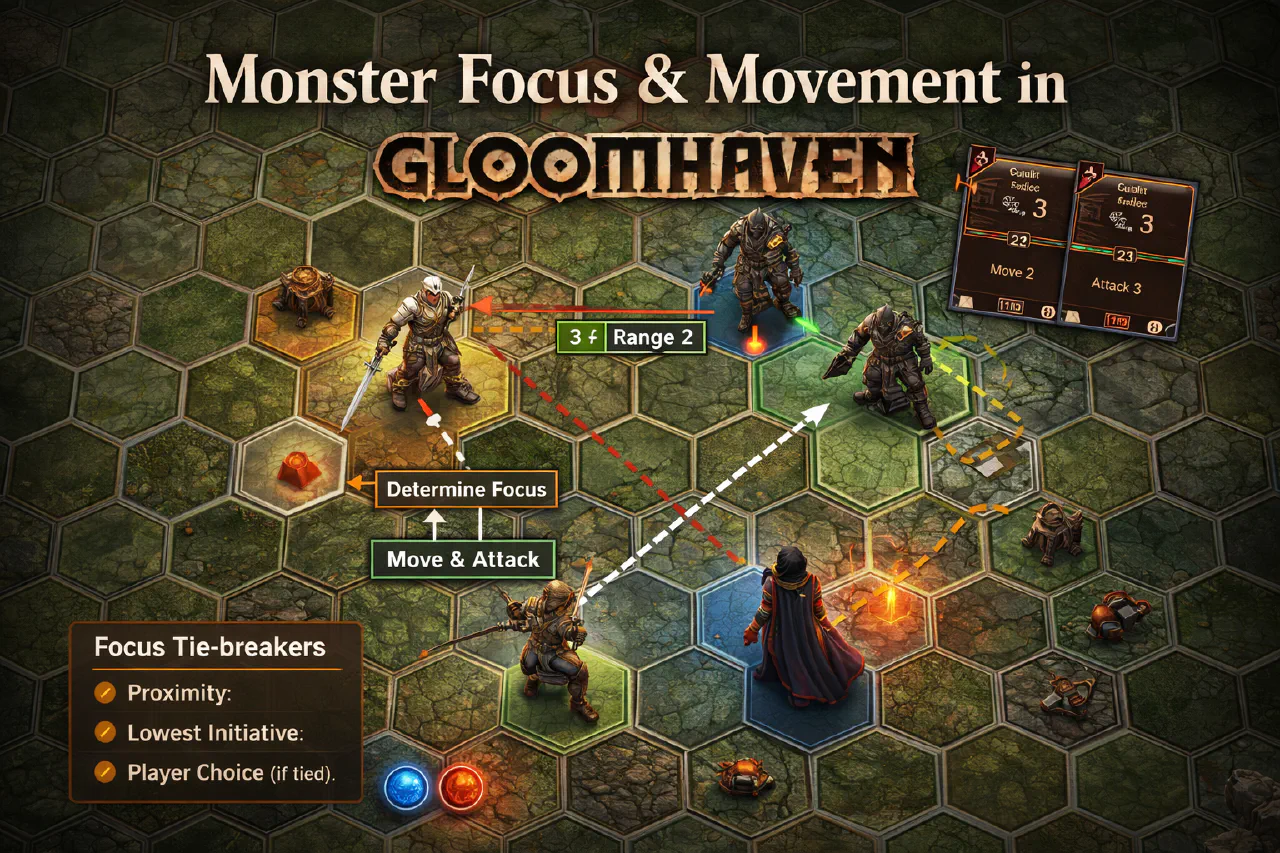
Monster Focus & Movement in Gloomhaven: Steps and Examples
Learn exactly how monsters choose focus, where they move, and when they stop. Spoiler-free, rules-accurate, with a simple flowchart and common edge cases.
How Monster Ability Cards Work (Why Enemies Feel Swingy)
A clear, beginner-friendly explanation of Gloomhaven monster ability cards: what they do, how they determine monster actions, and why enemy behavior sometimes feels unpredictable.
Looting Rules Explained in Gloomhaven — Timing, Range, and Greed
A clear, spoiler-free guide to how looting works in Gloomhaven: how you pick up coins and treasure tiles, when looting happens, how range works, and practical tips to make sure you don’t miss out.