
On this page
An enhancement’s price is its adjusted base cost, plus 25 gold per card level above 1, plus 75 gold per existing sticker on the same action. Multi-target abilities double the base cost, while adding an attack hex uses a separate base-price formula.
This calculator uses original Gloomhaven, first-edition permanent enhancement costs. It does not apply Frosthaven, Gloomhaven second-edition, or digital variant prices. Standalone Jaws of the Lion does not use card enhancement; the dots on Jaws cards support crossover use with the larger game.
Spoiler scope: This page describes enhancement rules and prices, but no scenario solution, unlock location, or locked class.
Enhancement cost calculator
Choose the sticker, the ability card’s level, and the number of stickers already on that card half. Calculate one new sticker at a time. The result updates as you change the fields.
This tool prices your selection; it does not inspect a card or confirm legal sticker placement. Check the enhancement dot, permitted sticker type, campaign unlock, and prosperity limit before paying.
Enhancement cost:
- Base sticker price
- Base after
- Card-level surcharge
- Existing-sticker surcharge
How the price is calculated
For an ordinary sticker:
Cost = base price × target multiplier + 25 × (card level − 1) + 75 × existing stickers on that action.
The target multiplier is 2 for an ability that affects multiple figures, otherwise 1. It doubles only the base sticker price. Do not double the card-level or existing-sticker surcharges.
An action is the entire top or bottom half of a card. If the top has two abilities and one already has a sticker, a new sticker anywhere on that top action pays the previous-enhancement surcharge. A sticker on the bottom does not increase that top action’s price.
Level X cards use the same level surcharge as level 1 cards: zero. Use the level printed on the ability card, not your character level, scenario level, or prosperity.
Example: multi-target Attack +1
Add Attack +1 to a level 3 card’s multi-target attack, with no existing stickers on that action:
- Base Attack +1: 50 gold.
- Multi-target multiplier: 50 × 2 = 100 gold.
- Level 3 surcharge: 50 gold.
- Previous-sticker surcharge: 0 gold.
Total: 150 gold. Doubling the entire subtotal would overcharge you.
Example: Strengthen on a self-heal
Assume a level 1 card has an eligible dotted main Heal ability affecting only yourself. Adding Strengthen has a base price of 50 gold, no level surcharge, and no multi-target multiplier. With no previous stickers on that half, the total is 50 gold.
If the same action already has one sticker, the next enhancement costs 125 gold instead. A Move ability does not count as affecting yourself for adding Bless or Strengthen: the cheaper price does not make that placement legal.
Base enhancement prices
These are sticker base prices before multi-target doubling and surcharges.
| Numerical enhancement | Base price |
|---|---|
| Move +1 | 30 gold |
| Attack +1 | 50 gold |
| Range +1 | 30 gold |
| Shield +1 | 100 gold |
| Push +1 | 30 gold |
| Pull +1 | 30 gold |
| Pierce +1 | 30 gold |
| Retaliate +1 | 100 gold |
| Heal +1 | 30 gold |
| Target +1 | 50 gold |
Target +1 increases an existing dotted numerical Target line. It does not add a new Target line to an ordinary single-target attack. For an ability already affecting multiple figures, the base 50 gold becomes 100 gold before the other surcharges.
| Added effect | Base price |
|---|---|
| Poison | 75 gold |
| Wound | 75 gold |
| Muddle | 50 gold |
| Immobilize | 100 gold |
| Disarm | 150 gold |
| Curse | 75 gold |
| Strengthen | 50 gold |
| Bless | 50 gold |
| Jump | 50 gold |
| Infuse one specific element | 100 gold |
| Infuse any element, chosen when used | 150 gold |
“Specific element” means choosing a fixed element sticker such as Fire or Ice. The more expensive wild sticker permits choosing the element during play. Do not treat all element stickers as the same price.
The original game’s sticker options do not include adding Stun or Invisible through this price table. Negative conditions require eligible main abilities targeting enemies. Bless and Strengthen require eligible main abilities benefiting yourself or allies. Jump is for a Move line; element stickers require an eligible main ability line.
Summon base stats
Select the separate summon option when enhancing a dotted summon base stat. An ordinary Attack +1 price is not the summon Attack +1 price.
| Summon stat enhancement | Base price |
|---|---|
| Summon Move +1 | 100 gold |
| Summon Attack +1 | 100 gold |
| Summon Range +1 | 50 gold |
| Summon HP +1 | 50 gold |
Summoning several creatures does not, by itself, make that summon ability multi-target for enhancement pricing in original Gloomhaven. Do not check the multi-figure option simply because more than one creature is summoned. The ordinary card-level and previous-sticker surcharges still apply.
Adding an attack hex
For one new red attack hex, the base price is:
200 gold ÷ the number of hexes currently targeted by the attack, rounded down.
Count the current red pattern hexes, including red hexes added by previous enhancements. Do not count a grey hex marking the attacker. Use the pattern’s hex count, not the number of monsters standing in it during a particular turn.
Attack-hex stickers do not get the multi-target doubling. Add the card-level and existing-sticker surcharges after finding the base price.
Example: a second enhancement on a level 3 action
A level 3 action already has one enhancement, and its area pattern currently targets three hexes. Adding one attack hex costs:
floor(200 ÷ 3) + 50 + 75 = 66 + 50 + 75 = 191 gold.
If you then add another hex to that same action, recalculate. The pattern now has four red hexes, and the action has two existing enhancements. The next hex costs 50 + 50 + 150 = 250 gold. Do not multiply the first quote by the number of stickers you want to buy.
When does multi-target doubling apply?
Evaluate the ability being enhanced, rather than counting every ability on the card half. An action with two separate single-target attacks is not automatically a multi-target ability. An area attack or an ability that affects several allies can qualify even if only one figure happens to be in range when used.
In original Gloomhaven, the FAQ treats an otherwise single-target ability that gains multiple enemies only by consuming an element as single-target for enhancement pricing. Do not import the later-edition conditional-target rule. The calculator lets you choose the target multiplier so you can apply the appropriate first-edition ruling to your card.
For the distinction between separate abilities and several targets, see multiple attacks versus multiple targets.
Check whether you can buy the enhancement
The standard campaign requires the enhancement system to have been unlocked, and purchases happen while visiting Gloomhaven. The character whose card is enhanced pays the cost. A valid price is not permission to enhance a card before the campaign allows it.
There is also a limit on the number of enhanced cards in the class’s ability deck: it cannot exceed the town’s prosperity level. This counts cards across the class’s full deck, not just the current scenario hand. Several stickers on one card still occupy one enhanced-card slot, although they can add cost when placed on the same action.
Permanent enhancements remain on that class’s cards after retirement. Earlier stickers therefore still matter when another character of that class wants to add a new enhancement.
Common pricing mistakes
- Using character level: the surcharge follows the ability card’s printed level.
- Counting the opposite half: previous-sticker charges apply to the same top or bottom action.
- Doubling everything: multiply only the base price for multiple figures.
- Halving loss actions: this calculator follows the original first-edition rules, which do not add a blanket loss-action discount.
- Applying shop reputation discounts: ordinary item-shop price adjustments do not change the enhancement table.
- Assuming affordable means legal: you still need an eligible dot and a permitted sticker.
If you are checking other campaign setup numbers, use the scenario-level calculator. For how an added condition actually behaves during play, see conditions and timing.
Rules references
- Original Gloomhaven rulebook pp. 45–47, Enhancing Ability Cards and the complete cost table: searchable transcription of publisher material, hosted unofficially. The 150-gold attack and 191-gold attack-hex examples match the printed examples on p. 47.
- Original-game FAQ clarifications, reproduced by Dized: conditional multi-target abilities and element consumption, Bless and Strengthen placement, and the enhancement section of the original-game FAQ for summon and prosperity-counting clarifications.
Next reads
Keep going with spoiler-light, practical guidance.
Gloomhaven Advantage, Disadvantage, and Rolling Modifiers
Resolve advantage and disadvantage with worked examples, original Gloomhaven rolling-modifier rules, Jaws ambiguity rules, and Bless and Curse timing.
Gloomhaven Scenario Level Calculator and Difficulty Guide
Calculate scenario difficulty for original Gloomhaven and Jaws of the Lion, including monster level, trap damage, gold, bonus XP, and original-game solo rules.
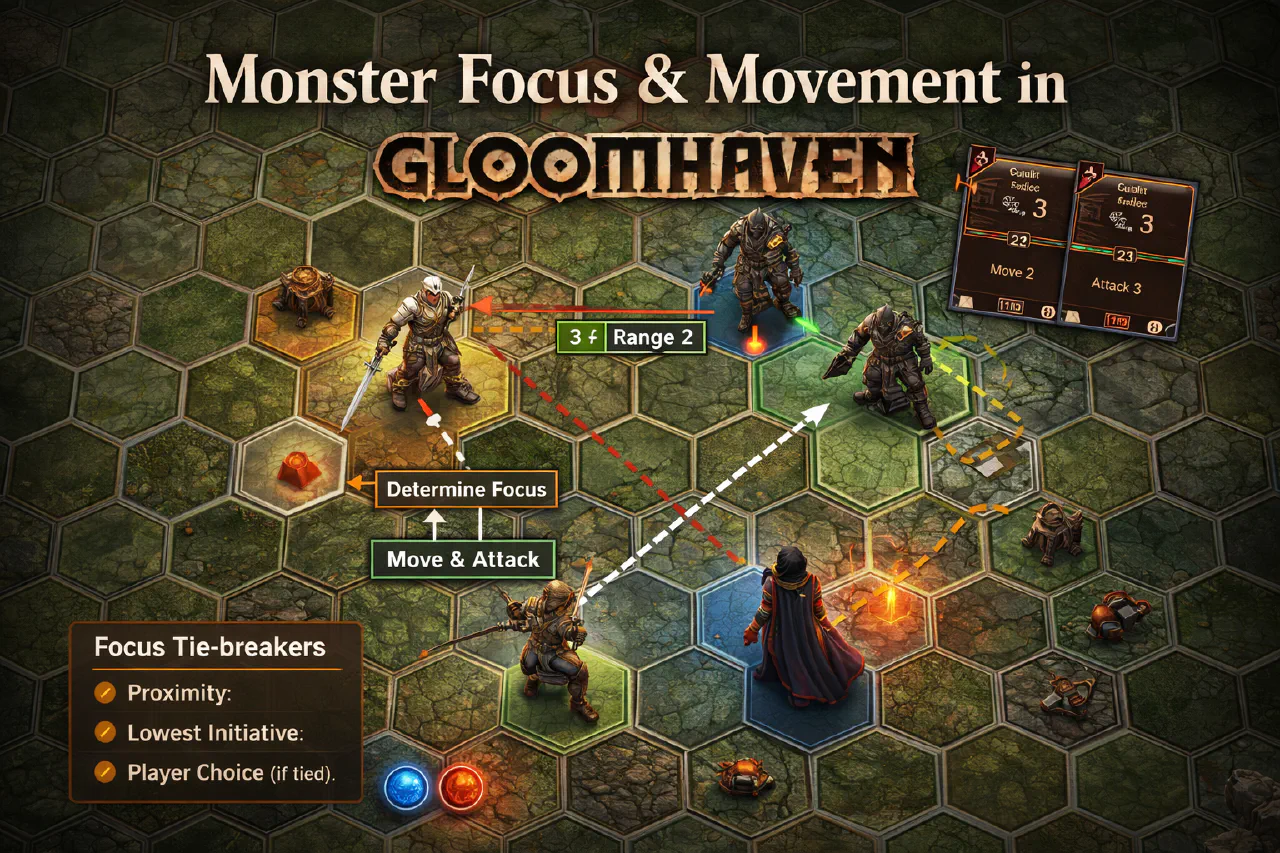
Monster Focus & Movement in Gloomhaven: Steps and Examples
Learn exactly how monsters choose focus, where they move, and when they stop. Spoiler-free, rules-accurate, with a simple flowchart and common edge cases.
How Monster Ability Cards Work (Why Enemies Feel Swingy)
A clear, beginner-friendly explanation of Gloomhaven monster ability cards: what they do, how they determine monster actions, and why enemy behavior sometimes feels unpredictable.
Looting Rules Explained in Gloomhaven — Timing, Range, and Greed
A clear, spoiler-free guide to how looting works in Gloomhaven: how you pick up coins and treasure tiles, when looting happens, how range works, and practical tips to make sure you don’t miss out.