
On this page
Only walls block line of sight. Figures and obstacles do not. To attack a target, you need a clear straight sight line as well as enough range.
The endpoints depend on your game: original Gloomhaven checks corner to corner; Jaws of the Lion checks any part of one hex to any part of the other. In either game, the line must avoid touching a wall.
Games covered: Original Gloomhaven (first edition) and Gloomhaven: Jaws of the Lion. Use the matching method below, particularly around doors and tight corners.
Line of sight in Gloomhaven vs Jaws of the Lion
| Question | Original Gloomhaven | Jaws of the Lion |
|---|---|---|
| Where can the line begin and end? | Any corner of your hex to any corner of the target’s hex | Any part of your hex to any part of the target’s hex |
| Must I check from the miniature’s position? | No; use the hex | No; use the hex |
| Do walls block the line? | Yes, including contact with a wall edge or corner | Yes; the line cannot touch a wall line |
| Do figures or obstacles block it? | No | No; objectives also do not block it |
| Do attacks need it? | Yes, both melee and ranged | Yes, both melee and ranged |
| What about other abilities? | An ability with a specified range requires it; non-attack abilities without a specified range do not | Targeted abilities require sight to their target; non-targeted effects have their own rules |
The original rulebook, p. 19, and the Jaws Glossary, p. 13, establish those different methods. A corner-to-corner line that works in original Gloomhaven also works in Jaws, but Jaws does not restrict you to corners.
How to check a sight line
- Identify the target hex and your game. You are testing spaces, not whether the miniatures can physically see each other.
- Choose permitted endpoints. In original Gloomhaven, try pairs of hex corners. In Jaws, you may also use points along an edge or inside a hex.
- Draw one straight line. It cannot bend through a doorway or around a wall.
- Check the whole line for walls. Touching a blocking wall is enough to invalidate that candidate.
- Try another pair if necessary. One clear legal line establishes sight. One blocked line does not prove sight is impossible.
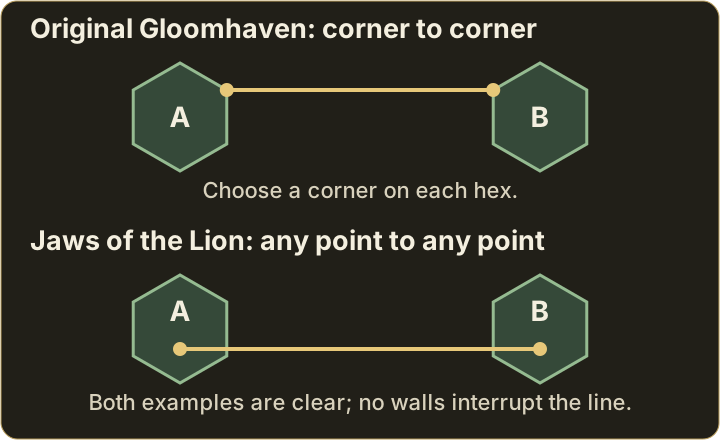
Both examples have line of sight. The difference shown is which endpoints the game permits.
You do not need a clear center-to-center line in original Gloomhaven. Equally, in Jaws you should not reject a target solely because you tested only the corners. If the view is tight, use the actual printed map boundary and the rule for your game.
What blocks line of sight?
Walls and closed doors block it
A wall blocks the sight line even if the enemy is very close. Closed doors count as walls until opened. A pair of spaces separated by a wall is not adjacent merely because their artwork appears to meet.
In original Gloomhaven, wall areas include the map-tile boundary and partial edge hexes described in the rulebook, unless an overlay changes that area. In Jaws, follow the printed wall lines on the scenario map. Do not assume that every dark patch of art is a wall.
The wall-corner clarification explains why a line that merely clips a wall still fails in original Gloomhaven.
Figures, obstacles and terrain do not block it
An ally between you and a monster does not shield the monster from your ranged attack. An obstacle may stop normal movement without stopping your attack. Traps and difficult terrain do not create walls either.
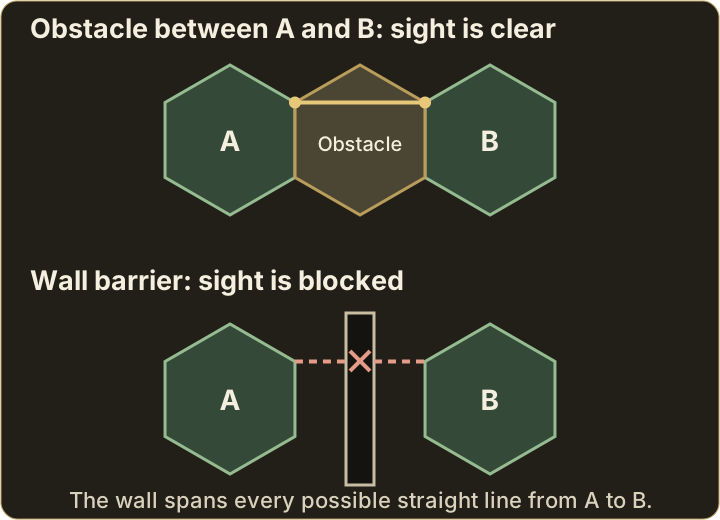
Movement blocking and sight blocking are different. These two outcomes are the same in both games.
Worked example: Your character and an enemy stand on opposite sides of a one-hex obstacle. The enemy is two hexes away, and no wall interrupts a valid sight line. A Range 2 attack can target it even though you cannot walk straight through the obstacle. If a continuous wall separates the two instead, the attack cannot target it from there.
For movement through obstacles and terrain, use Jump vs Flying.
Range and line of sight are separate checks
Range counts hex distance, without counting through walls. Sight tests a straight line using the permitted endpoints. Having one does not guarantee the other.
- Visible but too far away: A target four hexes away across an open room is visible, but a Range 3 attack cannot reach it.
- Within range but hidden: Around a corridor bend, you may be able to count a short path of hexes without crossing walls, yet no straight line connects your hex to the target’s hex. Enough range does not let the attack bend around the corner.
- Visible across an obstacle: Movement may need a detour, but attack range is not the cost of walking to the target.
Before playing a turn that depends on an attack, identify the hex you will attack from and check both requirements there. Our positioning guide explains how to choose useful attack positions.
Melee and area attacks still need sight
Melee attacks require line of sight too. Do not attack through a wall just because two spaces look close together. Walls also affect whether the spaces are adjacent.
For an area attack, check sight to each enemy you intend to attack. A target inside the printed pattern is not automatically legal if a wall blocks it. One visible enemy does not make every enemy in the pattern visible. The original rulebook explains this under Area Effects, p. 21.
These are targeting checks, not tests of whether an attack would hit an intervening obstacle. The obstacle itself does not block sight.
Non-attack abilities: check the game’s rule
In original Gloomhaven, non-attack abilities without a specified range do not need line of sight. If an ability specifies a range, the sight requirement applies. Do not extend the no-range exception to attacks.
In Jaws, a targeted ability needs sight to its target. For instance, its Heal and granted-action rules expressly require sight to the affected figure. A non-targeted effect that simply makes figures suffer damage can work differently; read that effect rather than treating all damage as an attack. See the Jaws Glossary, Line-of-Sight, p. 13, and Suffer Damage, p. 20.
Looting has its own rules for collecting tokens rather than targeting figures. Original Gloomhaven explicitly treats a Loot ability as ranged for sight purposes; see Loot, p. 27. Check the matching game’s loot rules rather than inferring token collection from the figure-targeting table above.
Monsters can focus on someone they cannot currently see
A monster’s current sight line is not a prerequisite for choosing its focus. Focus considers a path to a position where the monster could attack; the monster then needs sight from its actual attacking position to perform the attack.
For example, an enemy around a corner may be a monster’s focus because there is a valid route to attack them. That does not let the monster fire through the wall from where it starts. See Monster Focus and Movement for the movement procedure and game-specific notes.
A quick table check
Before resolving a doubtful attack, ask:
- Which game are we playing, and which endpoints does it allow?
- Is there at least one straight line that avoids the walls?
- Am I mistaking an obstacle or figure for a wall?
- Is the target also in range without counting through walls?
- If this is an area attack, have I checked each target separately?
If moving one hex would fix an unclear shot, check the new position before committing your movement. That is usually faster than discovering the problem after the move is spent.
Rules references
- Original Gloomhaven: Rulebook pp. 19–21, Attack and Area Effects; p. 27, Loot; pp. 29–30, Monster Focus. The searchable transcription reproduces the publisher’s rules.
- Jaws of the Lion: Glossary p. 13, Line-of-Sight; p. 8, Door; p. 11, Heal; p. 20, Suffer Damage; p. 21, Wall. The link is a hosted copy of the publisher’s glossary.
Next reads
Keep going with spoiler-light, practical guidance.
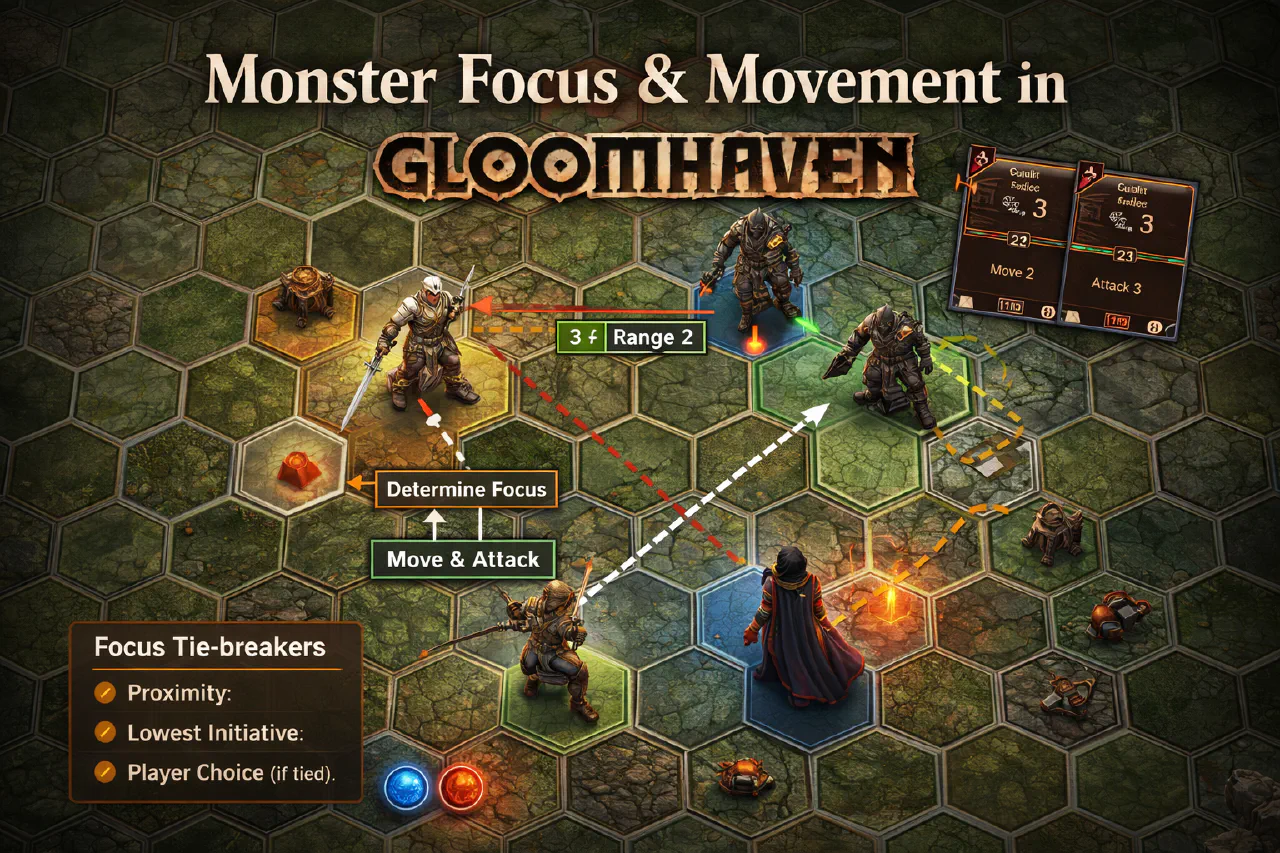
Monster Focus & Movement in Gloomhaven (Beginner Flowchart + Examples)
Learn exactly how monsters choose focus, where they move, and when they stop. Spoiler-free, rules-accurate, with a simple flowchart and common edge cases.
How Monster Ability Cards Work (Why Enemies Feel Swingy)
A clear, beginner-friendly explanation of Gloomhaven monster ability cards: what they do, how they determine monster actions, and why enemy behavior sometimes feels unpredictable.
Looting Rules Explained in Gloomhaven — Timing, Range, and Greed
A clear, spoiler-free guide to how looting works in Gloomhaven: how you pick up coins and treasure tiles, when looting happens, how range works, and practical tips to make sure you don’t miss out.
Gloomhaven Jump vs Flying: Difficult Terrain, Traps and Movement
Learn how Jump, Flying, difficult terrain, and traps interact in Gloomhaven, including the different jump landing cost in Jaws of the Lion.
Conditions Explained in Gloomhaven (What They Do and When They End)
A clear, beginner-friendly guide to all conditions in Gloomhaven: what each condition does, when it applies, when it is removed, and common rules mistakes.