
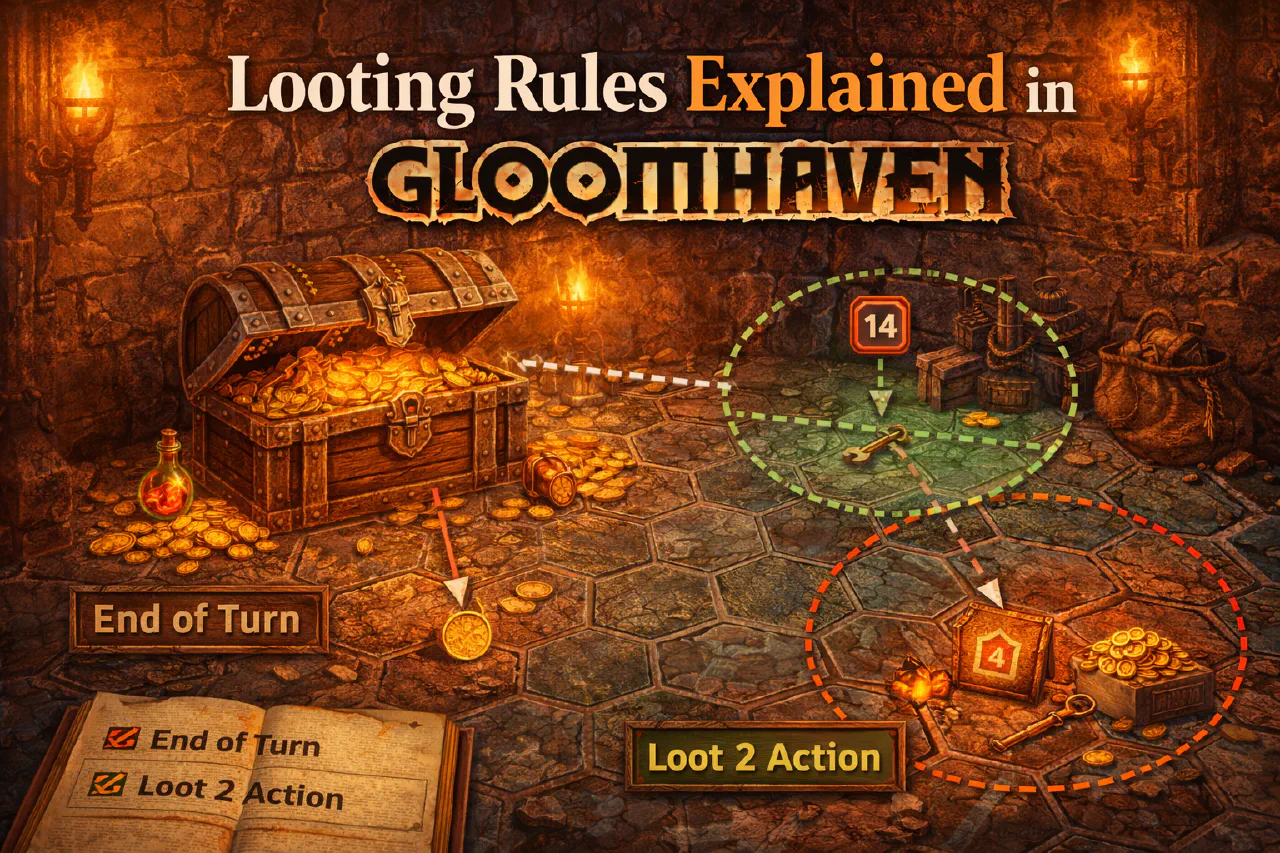
On this page
Looting Rules Explained in Gloomhaven — Timing, Range, and Greed
Looting is a fun and thematic part of Gloomhaven, but it’s also one of the mechanics that new players most often misunderstand. Getting loot right improves your gold income, your item pool, and makes sure you don’t miss rewards you earned. This guide explains when and how looting actually works, clears up common confusions, and gives you simple table rules you can use instantly.
What Counts as Loot?
In Gloomhaven, loot includes:
- Money tokens dropped by monsters
- Treasure tiles (numbered tiles on the map)
- Goal tiles when the scenario specifies
- Gold from monster drops or scenario rewards (but see money token rules below)
Treasure tiles are what most players think of first because they often contain items, item designs, or gold.
How Do You Loot? (Actions vs End of Turn)
There are two main ways to loot in Gloomhaven:
1) Using a Loot Action
Some cards (or items) have a Loot X ability.
- When you use a Loot X action, you pick up every money token and treasure tile within X hexes of your character.
- You don’t get to choose one and ignore another — the action applies to all eligible tiles in range.
- These are ranged abilities, so you also must obey line of sight rules to the tiles you’re looting.
For example, Loot 1 means:
Pick up all tokens and treasure tiles in your hex and every adjacent hex.
This is often how you pull distant chests or money tokens toward you without physically moving onto them.
2 End-of-Turn Looting
Even if you don’t use a special loot action, you still automatically loot:
- All money tokens
- All treasure tiles
that are in the same hex as your character at the end of your turn.
This is not an action — it just happens whenever your turn ends in a hex with loot.
Range and Line-of-Sight (for Loot Actions)
- Loot actions like Loot 2 use a range X, just like ranged attacks and other abilities.
- You must have line of sight to the loot tile for ranged looting to work.
- Range and LOS don’t matter for end-of-turn looting, because you’re standing on the loot.
What Happens When You Loot Something?
Here’s what happens depending on what you pick up:
Treasure Tiles
- When you loot a treasure tile, remove it from the board and immediately reference its number in the scenario book to see what the reward is.
- Whatever the scenario indicates (gold, item, or item design), the looting character gets that reward.
Money Tokens
- Pick up the tokens and add them to your personal stash. (Campaign / house-rule handling may vary, but the physical tokens you pick up are what counts.)
Items
- If the treasure gives you an item, add it to your inventory.
- You cannot equip it until between scenarios (because equipping happens only then).
- If you already own a copy of that item, you usually immediately sell it to the city market for half its value, and the item becomes available in the city supply.
Item Designs
- If the treasure gives an item design, everyone gets access to that design in the shop — but no character instantly gets an item copy.
Goal Tiles Are Special
Some scenarios have goal tiles that must be looted as part of the victory condition.
- Goal tiles are tied to scenario completion, not the campaign.
- If you replay the same scenario later, goal tiles reset and can be looted again.
Always read the scenario text closely — some goals count as looting actions for scenario rules.
What Loot Belongs To Whom?
- Only the character who loots the tile (either via action or end-of-turn) gets the treasure.
- Loot isn’t shared automatically — this is often the biggest source of “who owns this?” arguments.
If someone else wants a chest reward, you must trade or sell for gold between scenarios.
Common Looting Misunderstandings
“Looting automatically gives you gold at the end.”
No — you must either:
- enter the hex (end-of-turn pickup), or
- use a Loot action with range/Line-of-sight.
“Once you complete the scenario, all nearby tokens are theirs.”
By the rules, looting happens when the turn ends — not after the scenario completes. If no one stood there earlier, those tokens stay on the board at the scenario’s end.
“Monsters steal treasure.”
Monsters do not loot treasure tiles, even if they have Loot actions. They only pick up money tokens when their abilities specify.
- Standing on a coin or chest at end of turn = you pick it up.
- Loot X actions pick up everything in range X.
- Must have line of sight for ranged looting.
- Only the looting character gets the reward.
- Equip new items only between scenarios.
Strategic Loot Tips
- Try to plan movement so you end your turn on a treasure tile before scenario victory — that way you don’t miss it.
- Use Loot actions to grab money and nearby tiles without detouring.
- Coordinate who loots what — gold and items can be scarce in early campaigns.
- If you already have an item copy, know that selling it later still benefits the group.
Next reads
Keep going with spoiler-light, practical guidance.
Monster Focus & Movement in Gloomhaven (Beginner Flowchart + Examples)
Learn exactly how monsters choose focus, where they move, and when they stop. Spoiler-free, rules-accurate, with a simple flowchart and common edge cases.
How Monster Ability Cards Work (Why Enemies Feel Swingy)
A clear, beginner-friendly explanation of Gloomhaven monster ability cards: what they do, how they determine monster actions, and why enemy behavior sometimes feels unpredictable.
Gloomhaven Line of Sight: Walls, Corners and Jaws of the Lion Rules
Check line of sight in Gloomhaven and Jaws of the Lion with hex diagrams, game-specific targeting rules, and clear examples of what blocks an attack.
Gloomhaven Jump vs Flying: Difficult Terrain, Traps and Movement
Learn how Jump, Flying, difficult terrain, and traps interact in Gloomhaven, including the different jump landing cost in Jaws of the Lion.
Conditions Explained in Gloomhaven (What They Do and When They End)
A clear, beginner-friendly guide to all conditions in Gloomhaven: what each condition does, when it applies, when it is removed, and common rules mistakes.