
On this page
Normal scenario level is the average character level divided by two, rounded up. Two level 2 characters therefore play at scenario level 1 on Normal, not level 2. Difficulty changes that result; character count separately determines which enemies you set up.
Use the calculator below for original Gloomhaven (first edition) or Jaws of the Lion. It does not use second-edition or Frosthaven rules. During the Jaws tutorial, follow the Learn to Play Guide’s scenario-specific setup instead of replacing it with this general calculation.
Scenario level calculator
Enter the levels of the characters actually taking part, including multiple characters controlled by one person. The result updates when you change a field. Scenario-specific trap damage or other special instructions take precedence over the general table.
Scenario level
- Monster level
- Trap damage
- Gold per money token
- Bonus XP per character on success
How to calculate difficulty by hand
- Add the participating characters’ levels.
- Divide by the number of participating characters to find the average.
- Divide that average by two.
- Round up to a whole number to find the Normal recommendation.
- Apply your chosen difficulty adjustment.
Do not round the character average before dividing it by two. Only round up the final half-average. The ordinary scenario-level range is 0–7; Easy cannot reduce it below 0.
| Difficulty | Adjustment to the Normal recommendation |
|---|---|
| Easy | −1 |
| Normal | +0 |
| Hard | +1 |
| Very Hard | +2 |
For a party at levels 6, 4, 4, and 3, the total is 17. Divide by four for an average of 4.25, then by two for 2.125. Round up to scenario level 3 on Normal. Easy is level 2, Hard is level 4, and Very Hard is level 5.
The rulebooks specify choosing difficulty before the scenario. In original Gloomhaven, the level cannot change during the attempt. If you want an easier next attempt, choose that setting when setting up again.
Monster level, traps, coins, and completion XP
The ordinary tables for these two games give the following results. Bonus XP is awarded to each character on success, in addition to experience earned from abilities. Money conversion is gold per collected money token, not a bonus for every coin left on the map.
| Scenario level | Monster level | Trap damage | Gold per money token | Bonus XP on success |
|---|---|---|---|---|
| 0 | 0 | 2 | 2 | 4 |
| 1 | 1 | 3 | 2 | 6 |
| 2 | 2 | 4 | 3 | 8 |
| 3 | 3 | 5 | 3 | 10 |
| 4 | 4 | 6 | 4 | 12 |
| 5 | 5 | 7 | 4 | 14 |
| 6 | 6 | 8 | 5 | 16 |
| 7 | 7 | 9 | 6 | 18 |
A trap that applies only conditions does not automatically gain damage from this table. A card-created trap or a scenario with a specific damage value follows that instruction. See Jump, Flying, and terrain for when a trap triggers, and looting for collecting and converting money.
Original Gloomhaven solo and open information adjustment
Original Gloomhaven has a separate adjustment for one person controlling multiple characters. After choosing the scenario level, increase monster level by 1 and trap damage by 1, while retaining the gold conversion and completion XP of the chosen scenario level. The same variant can be used by a multiplayer group playing with fully open card information.
For example, choose scenario level 2 and apply the solo adjustment: use monster level 3, trap damage 5, gold conversion 3, and bonus XP 8. Raising the entire scenario level to 3 instead would incorrectly raise the completion XP to 10.
The printed solo table ends at scenario level 6 with monster level 7. If a combination would require monster level 8, the calculator asks you to choose a lower difficulty. It does not invent a new monster level or quietly cap it.
Jaws does not instruct players to add this original-game solo adjustment. Selecting Jaws disables that option. You can still choose Easy, Normal, Hard, or Very Hard using its own difficulty rules.
Does party size change the scenario level?
Not independently. Party size matters in the average because you include every participating character, but there is no additional level increase simply because four characters are present.
The scenario setup uses character count to decide which enemies appear and which are normal or elite. A two-person group controlling four characters uses the four-character setup. Do not reduce the setup to two characters just because two humans are at the table.
Why did the level change after only one character leveled up?
Rounding creates thresholds. Two level 2 characters average 2, so half the average is 1. If one reaches level 3, the average becomes 2.5; half is 1.25, which rounds up to 2. Both characters do not need to reach level 3 for the Normal recommendation to increase.
Check levels between scenarios, especially after someone levels up. An unexpectedly hard attempt may come from using the wrong monster-stat edge, an incorrect character-count setup, or automatically adding Move and Attack when a monster’s card does not list them. The common rules mistakes guide covers those checks.
Which difficulty should a new group choose?
Use the game’s recommended setup or tutorial as your starting point. If repeated attempts are frustrating, Easy is an available setting. Changing it is a choice about the experience you want, rather than evidence that you chose the wrong characters.
Before adjusting upward or downward, verify the calculation and the revealed monster abilities. Difficulty can magnify a rules error; it cannot fix one. For tactics after the setup is correct, see why you are losing scenarios.
For permanent ability-card upgrades in original Gloomhaven, use the separate enhancement-cost calculator.
Rules references
- Original Gloomhaven: Rulebook pp. 15–16, Scenario Level and Open Information and Solo Play; p. 13, character-count setup. Searchable transcription of the publisher’s book, hosted unofficially.
- Jaws of the Lion: Publisher’s Glossary, p. 13, Level (Scenario), and Trap p. 21. Hosted PDF copy. The Learn to Play Guide governs the opening tutorial.
Next reads
Keep going with spoiler-light, practical guidance.
Gloomhaven Advantage, Disadvantage, and Rolling Modifiers
Resolve advantage and disadvantage with worked examples, original Gloomhaven rolling-modifier rules, Jaws ambiguity rules, and Bless and Curse timing.
Gloomhaven Card Enhancement Cost Calculator
Calculate original Gloomhaven enhancement prices, including multi-target abilities, card level, existing stickers, summon stats, and extra attack hexes.
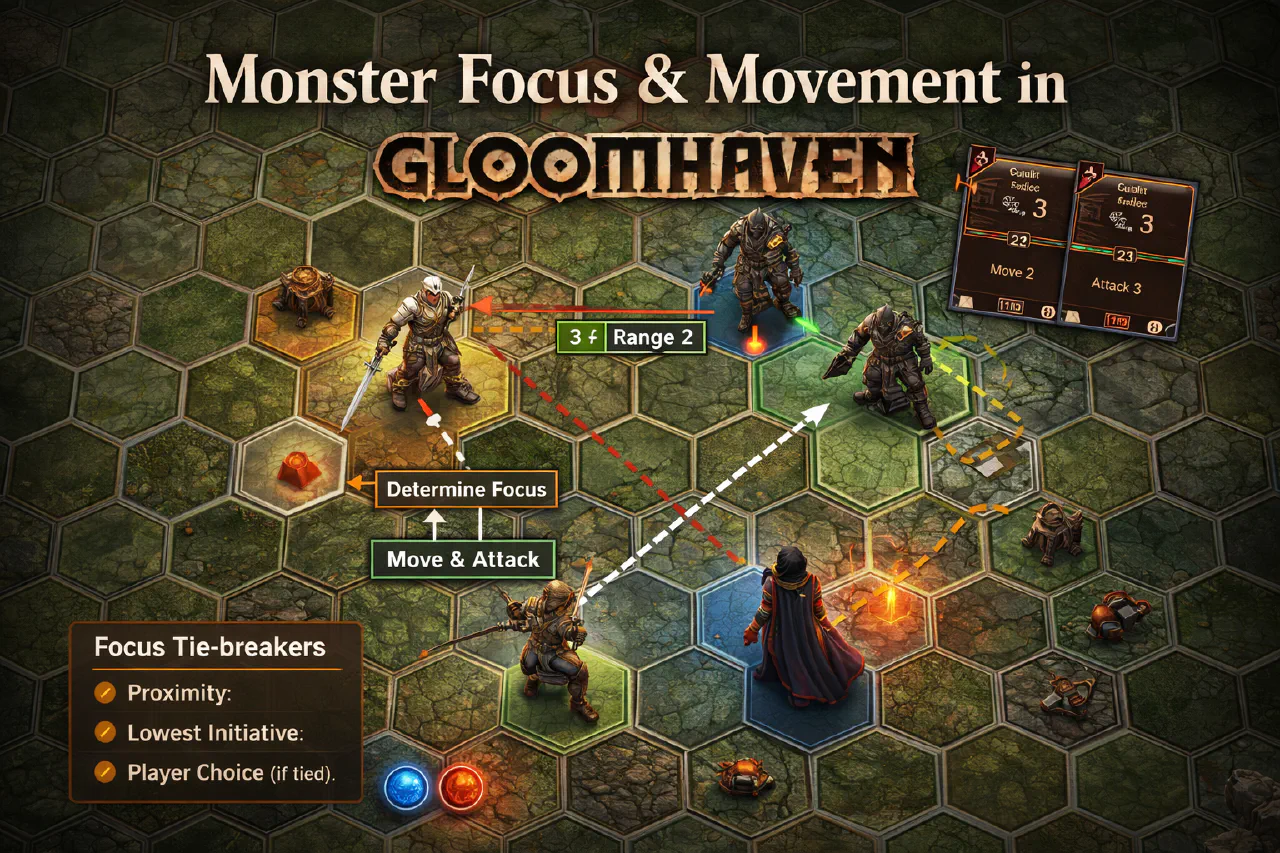
Monster Focus & Movement in Gloomhaven: Steps and Examples
Learn exactly how monsters choose focus, where they move, and when they stop. Spoiler-free, rules-accurate, with a simple flowchart and common edge cases.
How Monster Ability Cards Work (Why Enemies Feel Swingy)
A clear, beginner-friendly explanation of Gloomhaven monster ability cards: what they do, how they determine monster actions, and why enemy behavior sometimes feels unpredictable.
Looting Rules Explained in Gloomhaven — Timing, Range, and Greed
A clear, spoiler-free guide to how looting works in Gloomhaven: how you pick up coins and treasure tiles, when looting happens, how range works, and practical tips to make sure you don’t miss out.