
On this page
Monster Focus & Movement in Gloomhaven (Beginner Flowchart + Examples)
Monster AI is the #1 rules pain point for new groups—because it feels like enemies should “use line of sight” or “go for the closest character,” but Gloomhaven’s monsters follow a very specific (and very learnable) procedure.
This guide is spoiler-free and aimed at table use. It includes:
- a simple focus flowchart
- the key tie-breakers
- what monsters do about traps/hazardous terrain
- ranged monsters and disadvantage
- when monsters don’t move at all
The 60-second definition
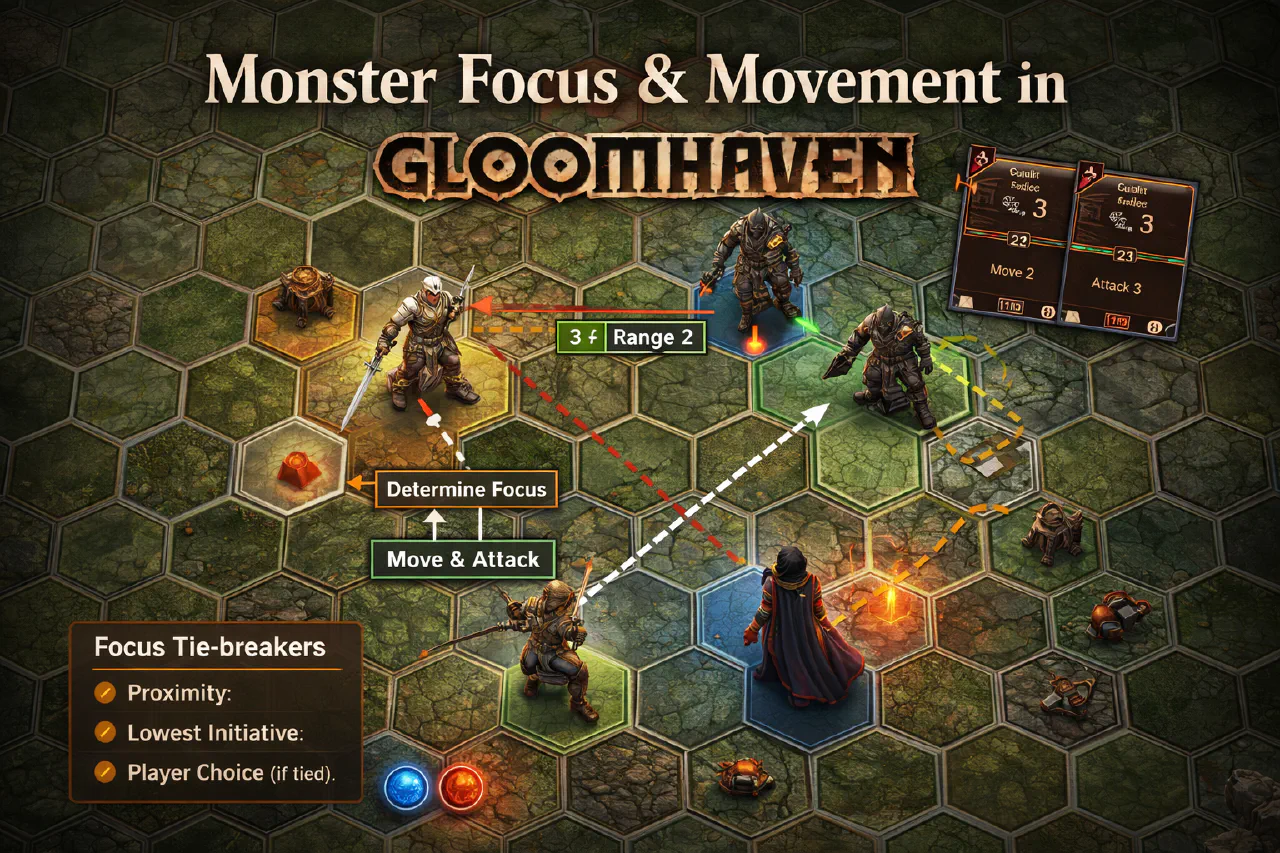
A monster’s focus is the enemy it can reach and attack with the least required movement along a valid path to an attack position.
If there’s a tie, monsters use tie-breakers (below).
A monster’s movement is then the minimum needed to move toward an optimal hex to attack its focus (and it often stops early).
Monster Focus Flowchart (use this every time)
Step 1 — Is the monster making an attack this turn?
Check its monster ability card.
- If it has an Attack, use that attack’s range (or the monster’s base range if the card doesn’t specify).
- If it does not have an Attack, it still finds focus by pretending it is making a melee attack (i.e., it wants to be adjacent).
Step 2 — Find the shortest “attack path” to each enemy (infinite movement)
For each enemy, imagine the monster has infinite movement and ask:
“What is the minimum movement needed to reach any hex where this monster could attack that enemy (range + line of sight)?”
Important details:
- It doesn’t matter if the monster can’t get there this round; if a valid path exists eventually, it counts.
- For this calculation, monsters treat other figures/obstacles/walls as blocking as normal (you’re looking for an unblocked path to a legal destination).
Step 3 — Choose the focus (least movement required)
Whichever enemy has the lowest required movement to reach an attack position becomes the focus.
Step 4 — Apply tie-breakers (in order)
If multiple enemies are tied for least movement:
- Proximity (distance in hexes, ignoring most stuff but respecting walls)
- If still tied: lowest initiative among those tied
- If still tied/ambiguous: players resolve the ambiguity (use your advantage). (GH2e explicitly notes ambiguity can be resolved in your favor in some cases, e.g., trap choices.)
Step 5 — Move (only as much as needed)
Once focus is chosen, the monster moves the minimum amount required to get closer to a hex where it can attack its focus (or to attack now, if possible). Monsters use minimum movement and often stop early.
If it can’t attack this round, it still moves toward the best future attack hex using the same logic.
Step 6 — Attack if it can
If, after moving, it has:
- target in range AND
- line of sight
it attacks. (Attacks require line of sight from the attacking hex; focus selection is about reaching a hex where that’s true.)
The most common misconceptions (and the correct ruling)
“Monsters need line of sight to choose focus”
Not quite. The focus process is about finding the shortest path to a hex where the monster could attack (which includes line of sight from that destination).
So a monster can “prefer” a target behind a corner because the shortest attack position is still closer.
“Monsters move their full Move value”
No—monsters use the minimum movement required to approach/perform their best attack on their focus.
“Monsters pick the closest enemy by raw distance”
No—minimum movement to an attack hex comes first; proximity is only a tie-breaker.
Ranged monsters and disadvantage (super important)
Monsters do not consider disadvantage when choosing focus.
So if a ranged monster is adjacent to one enemy but could attack someone else without disadvantage, it still focuses the adjacent enemy.
However, once focused, if it can move a little to remove disadvantage while still attacking its focus, it will move the minimum amount to do so (and in GH2e it avoids negative hexes while doing this).
Traps & hazardous terrain (negative hexes)
Monsters (without Flying) generally treat traps/hazardous terrain as obstacles when determining focus and paths— they prefer paths with fewer negative hexes, even if the safe path is much longer.
When does a monster NOT move?
A monster won’t move if:
- its ability card has no Move (obvious), OR
- moving wouldn’t get it closer to a hex where it can attack its focus, OR
- it’s already in a hex where it can make its best possible attack on its focus (e.g., already in range/LoS, or already minimized disadvantage).
The rulebook even gives examples where a ranged monster with Move 1 won’t step onto a trap to attack this turn because a “safe” path exists (even if it can’t reach it this round).
Quick and Practical Examples
Example 1 — “It can’t reach me this turn, so it won’t pick me”
Wrong.
If a valid path exists to eventually reach an attack hex against you, the monster still considers that path for focus—even if it can’t complete it this round.
Example 2 — Two targets tied on path length
If movement required to get into attack position is tied, use:
- proximity tie-breaker
- then lowest initiative among tied
Example 3 — Archer adjacent to a hero
Focus ignores disadvantage, so the adjacent hero is still the priority focus in GH2e.
Then the archer may step away the minimum amount to remove disadvantage if it can still attack its focus.
Quick Reference
- If no attack, pretend melee.
- Find the minimum movement (infinite move) to any hex where the monster could attack an enemy (range + LoS).
- Lowest movement = focus.
- Ties: proximity → lowest initiative.
- Move the minimum needed; don’t move extra.
- Attack if possible.
Next reads
Keep going with spoiler-light, practical guidance.
How Monster Ability Cards Work (Why Enemies Feel Swingy)
A clear, beginner-friendly explanation of Gloomhaven monster ability cards: what they do, how they determine monster actions, and why enemy behavior sometimes feels unpredictable.
Looting Rules Explained in Gloomhaven — Timing, Range, and Greed
A clear, spoiler-free guide to how looting works in Gloomhaven: how you pick up coins and treasure tiles, when looting happens, how range works, and practical tips to make sure you don’t miss out.
Gloomhaven Line of Sight: Walls, Corners and Jaws of the Lion Rules
Check line of sight in Gloomhaven and Jaws of the Lion with hex diagrams, game-specific targeting rules, and clear examples of what blocks an attack.
Gloomhaven Jump vs Flying: Difficult Terrain, Traps and Movement
Learn how Jump, Flying, difficult terrain, and traps interact in Gloomhaven, including the different jump landing cost in Jaws of the Lion.
Conditions Explained in Gloomhaven (What They Do and When They End)
A clear, beginner-friendly guide to all conditions in Gloomhaven: what each condition does, when it applies, when it is removed, and common rules mistakes.