
On this page
Jump ignores figures and terrain along the way, but landing matters. Flying ignores terrain even in the final hex. Neither lets you pass through walls or finish on another figure.
The most important game difference: a jump ending in difficult terrain costs 2 movement for its last hex in original Gloomhaven, but only 1 in Jaws of the Lion. In both games, landing a jump on a trap still springs it.
Games covered: Original Gloomhaven (first edition) and Gloomhaven: Jaws of the Lion. Flying and hazardous terrain below refer to original Gloomhaven; Flying is not a standard movement type in the Jaws base game. Use the scenario’s map key to identify terrain rather than guessing from the artwork.
Jump vs Flying: quick rules table
| Movement question | Normal movement | Jump | Flying — original Gloomhaven |
|---|---|---|---|
| Pass through an enemy or obstacle? | No | Yes | Yes |
| Pass through an ally? | Yes | Yes | Yes |
| Enter difficult terrain along the route? | Costs 2 per hex | Costs 1 per hex before landing | Costs 1 per hex, including landing |
| Finish in difficult terrain? | Costs 2 | Original Gloomhaven: 2; Jaws: 1 | Costs 1 |
| Cross a trap without triggering it? | No | Yes, if you do not end there | Yes |
| End on a trap without triggering it? | No | No | Yes |
| End on an obstacle? | No | No | Yes, if no figure is there |
| End on another figure? | No | No | No |
| Pass through a wall or closed door? | No | No | No |
A movement value is a budget, not a number of hexes you must travel. Jump does not add distance to the printed Move value, and Flying does not increase a monster’s Move value.
Difficult terrain costs movement for every hex entered
Normal movement costs 2 movement points each time you enter a difficult-terrain hex. Entering three consecutive difficult hexes costs 6; the penalty is not paid just once for entering a whole area. Your starting hex costs nothing to leave.
Difficult terrain slows movement. It is different from hazardous terrain, which deals damage, and from obstacles, which block normal movement. The original rulebook describes these terrain types on p. 14.
Example: three difficult hexes in a row
The illustrated route enters three difficult hexes, with no walls or figures on the route. The third hex is your destination.
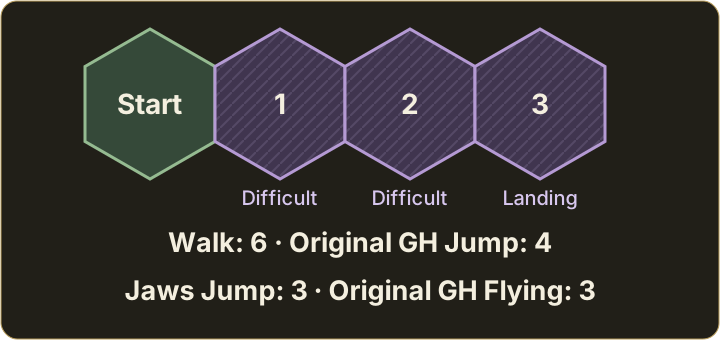
Count each entered hex. For Jump, check your game’s landing rule.
- Normal Move: 2 + 2 + 2 = 6 movement.
- Original Gloomhaven Jump: 1 + 1 + 2 = 4 movement.
- Jaws Jump: 1 + 1 + 1 = 3 movement.
- Original Gloomhaven Flying: 1 + 1 + 1 = 3 movement.
A Move 3 with Jump therefore reaches the destination in Jaws, but falls short of that destination in original Gloomhaven.
Jump landing rules: original Gloomhaven vs Jaws
Original Gloomhaven: the final hex uses normal movement rules
A Jump move ignores figures and terrain while crossing them. Its final hex follows normal movement rules: a difficult-terrain landing costs 2 movement, a trap landing triggers the trap, and you cannot land on an obstacle or another figure. Landing in hazardous terrain also causes its normal damage.
The Jump rule and difficult-terrain landing clarification cover the final-hex distinction.
Jaws of the Lion: difficult terrain does not add a landing cost
Jump costs 1 movement per hex even when it finishes in difficult terrain. You still need a legal destination without another figure or an obstacle, and a trap in the destination still triggers. Walls remain impassable. See the Jaws Learn to Play Guide, p. 21.
Example: crossing a trap versus landing on it
A trap lies between your starting hex and an ordinary open hex. A Move 2 with Jump can cross the trap and stop beyond it without springing it. If you instead finish the movement on the trap, it triggers. This outcome is the same in both games.
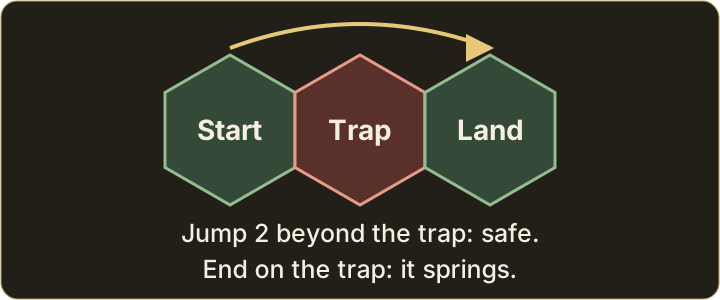
A trap crossed during the jump stays in place. A trap used as the landing hex springs.
Flying: terrain is ignored even where you stop
In original Gloomhaven, a flying figure can cross figures, obstacles, traps, and difficult or hazardous terrain. It can stop over an obstacle or trap if no other figure occupies that hex. It does not trigger the trap or suffer terrain damage while flying.
Flying also applies during pushes and pulls. It still does not permit movement through walls. If Flying ends while the figure is over an obstacle, special damage and relocation rules apply; do not simply leave the figure there. See the Flying rule.
Example: a flying enemy above a trap
A flying enemy is occupying a trap hex. Pushing that enemy to another trap hex does not spring either trap while it remains flying. A different, non-flying enemy pushed into an unoccupied trap hex would spring it.
Flying changes movement and terrain interactions. It does not make the figure immune to melee attacks or remove the need for line of sight.
How monsters handle difficult terrain
Players and monsters pay the same normal movement cost for difficult terrain. The monster-specific part is choosing a focus and path: count movement points, not just the number of hexes.
Suppose two legal paths reach the same attack position:
- Route A enters one difficult hex and then one ordinary hex: 3 movement.
- Route B enters three ordinary hexes: 3 movement.
The two-hex route is not cheaper. Both cost 3. A normal Move 2 cannot reach that attack position by either route.
Difficult terrain is also not a trap. It counts toward movement cost, but it does not have the special avoidance priority that monsters apply to traps. A flying monster ignores those terrain costs; a monster whose movement has Jump uses the appropriate Jump rules. The Jaws Glossary, p. 7 explicitly includes difficult terrain in focus calculations.
For the complete targeting procedure, read Monster Focus and Movement. Pay attention to that guide’s game-specific focus notes as well as the terrain rules here.
Push and Pull: no difficult-terrain surcharge
Push and Pull count hexes without paying extra for difficult terrain. A Push 2 can move a non-flying target through two difficult hexes, provided both steps follow the push direction and other movement restrictions.
Forced movement does not grant Jump. Pushing a non-flying figure into a trap triggers it; pushing one into hazardous terrain in original Gloomhaven causes its normal damage. Obstacles and walls still block a non-flying figure. The normal Push and Pull rules continue to apply.
Check these before moving
- Identify the game. Original Gloomhaven and Jaws differ on a Jump landing in difficult terrain.
- Read the movement. Normal Move, Jump, and Flying behave differently.
- Count each entered hex. Include the final hex’s cost.
- Check the destination. Jump cannot finish on a figure or obstacle; a trap landing still triggers.
- Keep walls in place. Jump and Flying cannot bypass them.
A good landing hex should also leave you ready for your next action. Our positioning guide explains why reaching a hex and choosing a useful hex are different decisions.
Rules references
- Original Gloomhaven: Rulebook p. 14, terrain; p. 19, Move; p. 22, Push and Pull; pp. 30–31, monster movement. The linked rulebook transcription reproduces the publisher’s rules; the Jump and Flying entries above provide focused references.
- Jaws of the Lion: Glossary pp. 7, 15 and 16, covering difficult terrain, Move/Jump, and Push/Pull. The linked glossary and Learn to Play Guide are hosted copies of the publisher’s documents.
Next reads
Keep going with spoiler-light, practical guidance.
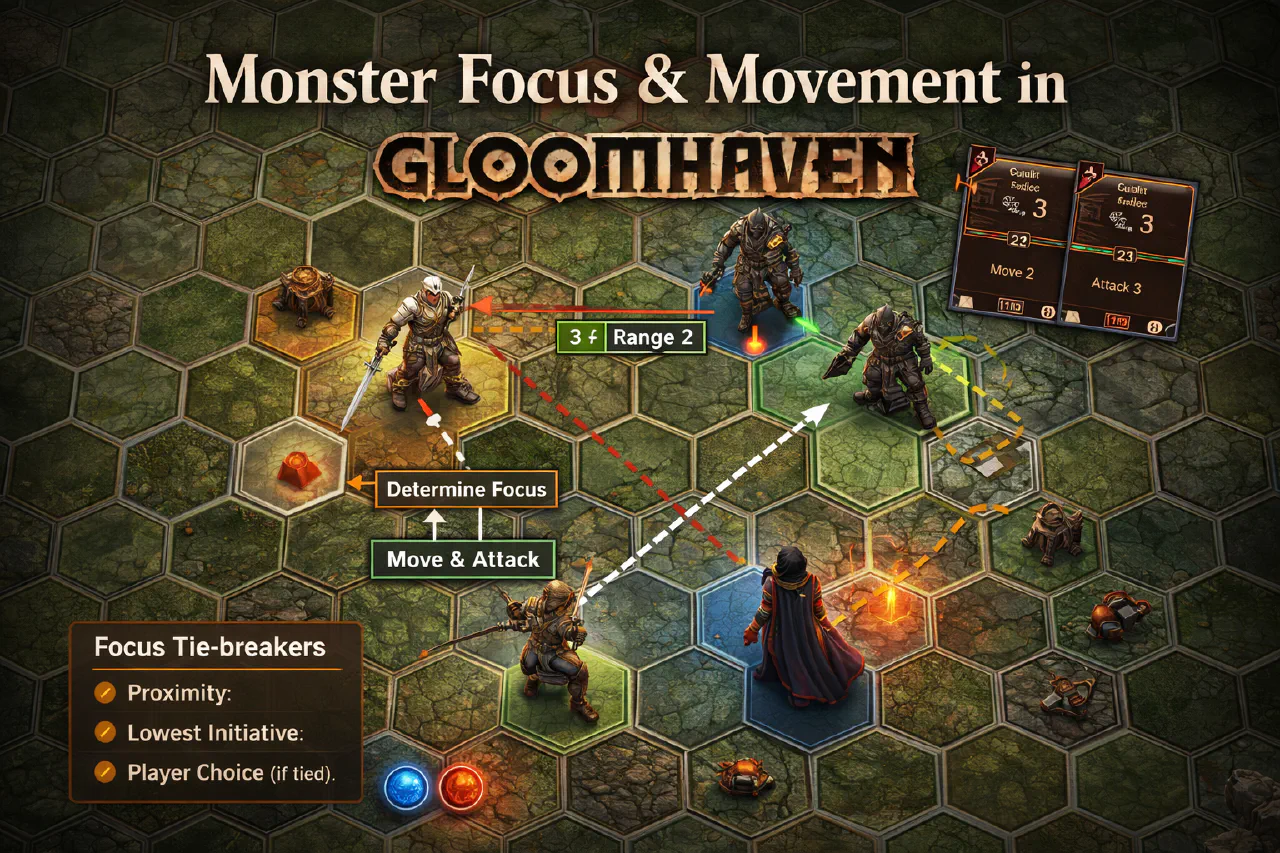
Monster Focus & Movement in Gloomhaven (Beginner Flowchart + Examples)
Learn exactly how monsters choose focus, where they move, and when they stop. Spoiler-free, rules-accurate, with a simple flowchart and common edge cases.
How Monster Ability Cards Work (Why Enemies Feel Swingy)
A clear, beginner-friendly explanation of Gloomhaven monster ability cards: what they do, how they determine monster actions, and why enemy behavior sometimes feels unpredictable.
Looting Rules Explained in Gloomhaven — Timing, Range, and Greed
A clear, spoiler-free guide to how looting works in Gloomhaven: how you pick up coins and treasure tiles, when looting happens, how range works, and practical tips to make sure you don’t miss out.
Gloomhaven Line of Sight: Walls, Corners and Jaws of the Lion Rules
Check line of sight in Gloomhaven and Jaws of the Lion with hex diagrams, game-specific targeting rules, and clear examples of what blocks an attack.
Conditions Explained in Gloomhaven (What They Do and When They End)
A clear, beginner-friendly guide to all conditions in Gloomhaven: what each condition does, when it applies, when it is removed, and common rules mistakes.