
On this page
Short rest when you need a normal turn next round. Long rest when you can afford a turn to recover, especially if you need spent items back or want to choose which card to lose. Both require at least two discarded cards, and both lose one of them.
Games covered: Original Gloomhaven (first edition) and Gloomhaven: Jaws of the Lion. The resting procedure below applies to both. In the Jaws tutorial, short rests are introduced in scenario 1 and long rests in scenario 3; follow the tutorial’s rules as they are introduced.
Short rest vs long rest: quick comparison
| Question | Short rest | Long rest |
|---|---|---|
| When do you choose it? | At the end of a round | During card selection at the start of a round |
| When do cards come back? | Immediately during that end-of-round rest | On your turn at initiative 99 |
| Do you play two cards that round? | The rest does not replace a turn | No; long resting is your turn |
| Which discard is lost? | One at random, with one optional redraw for 1 damage | One you choose |
| Do you heal? | No | Perform Heal 2, Self |
| Do items recover? | No | Refresh spent items; consumed items stay consumed |
| Minimum discard pile | Two cards | Two cards |
The trade-off is acting now versus recovering more safely and predictably. A long rest is valuable, but a party member spending a whole round recovering may leave someone else handling the enemies or objective alone.
How to take a short rest
At the end of a round, if you have at least two cards in your discard pile:
- Shuffle those discards and randomly choose one to put in your lost pile.
- If you want to keep that card, you may suffer 1 damage and randomly lose a different discard instead. You can do this only once per short rest.
- Return the remaining discards to your hand.
The replacement card is lost, not discarded, and you cannot keep paying damage for another attempt. A short rest does not return cards that were already lost. See the Gloomhaven short-rest rules.
Example: protect one essential card
You have six discarded cards. The random loss is a card you need for the next room, so you take 1 damage and set that card aside while selecting a different random card from the other five. That second card is lost. The first card and the four remaining discards return to your hand.
You finish with five cards back and one card lost, whether or not you used the redraw. The damage buys one chance to protect the first card; it does not let you choose freely.
How to take a long rest
During card selection, declare a long rest instead of selecting two cards. You need at least two discards; your hand does not have to be empty.
On your turn at initiative 99:
- Choose one discard to lose, then return the other discards to your hand.
- Perform Heal 2, Self.
- Refresh your spent items.
You do not also get a normal top and bottom card action that turn. Enemies still act during the round, so plan for what can happen before initiative 99. See the Gloomhaven long-rest rules.
Spent items and consumed items are different
A spent item is rotated sideways when used; long resting makes it available again. A consumed item is flipped over and does not recover from a long rest. Check the item’s symbol rather than assuming all used equipment comes back.
Healing is not always two hit points
Poison prevents a heal from restoring hit points: the long rest’s heal removes the poison instead. If you have wound without poison, the heal removes wound and can restore up to 2 HP. If you have both, the heal removes both conditions but restores no HP. Wound can still damage you at the start of your resting turn, before that heal. See the Jaws Learn to Play Guide, p. 22.
When should you short rest or long rest?
| Situation | Usually favor | Reason |
|---|---|---|
| You must attack, move, or protect an objective next round | Short rest | You keep a normal turn |
| The room is clear and the next door can stay closed | Long rest | You have a chance to recover without adding new enemies |
| Several useful spent items need refreshing | Long rest | Recovering them may be worth more than one immediate turn |
| The objective has a tight round limit | Short rest | Spending a round resting may cost progress you cannot afford |
| Your teammates can handle the remaining threat | Long rest | They can create a recovery window for you |
| You are exposed to dangerous attacks | Assess before choosing | Long-rest healing at 99 may arrive too late; a short rest lets you act next round |
Example: an enemy must die next round
You end the round with no cards in hand and six discards. An enemy is threatening an objective, and your teammates cannot reliably remove it alone.
A short rest now gives you five cards for the next round. You can select two and help. A long rest next round also recovers five cards, but your turn goes to recovery while the enemy remains a threat.
Choose the short rest for the action you need, not because it recovers more cards. It does not.
Example: prepare for the next room
The room is clear. You have no cards in hand, six discards, two missing HP, and a useful spent item. No scenario rule is forcing you to hurry.
A long rest lets you choose the loss, heal, and recover the item. Agree on the pause before anyone opens the next door. If a teammate reveals enemies while you are resting, the situation that made the rest attractive has changed. Our doorway tactics guide explains how to coordinate that transition.
Do long rests make your cards last longer?
They can extend your time in the scenario by adding a resting round between card cycles. They do not give you more cards back than short rests.
Suppose you have ten discards and no other available cards. Either rest loses one and returns nine. With no additional losses or recovery effects, those nine cards support four normal two-card turns, leaving one card in hand.
A long rest adds its own round before those four active turns. A short rest at the end of the previous round lets those active turns start immediately. Extra time in the scenario is helpful only if the party can still meet the objective.
For the larger endurance problem, read Why You’re Running Out of Cards.
Common resting questions
Can I rest while I still have cards in hand?
Yes. Eligibility depends on having at least two discards. Resting early may be useful, but repeatedly resting before using available cards spends a loss for fewer actions between rests.
Can I short rest at the start of my turn?
No. The short-rest window is at the end of a round. If you start a round unable to select two cards, you can declare a long rest if eligible; otherwise you exhaust. Plan your next turn before passing the end-of-round rest window.
Can I long rest with no cards in hand?
Yes, with at least two discards. With two discards, you will recover only one card after the loss. The rest can keep you present for that round, but one card alone will not support a normal turn afterward.
Does a rest bring back lost cards?
Neither type does. Resting recovers discards and loses one of them. Any ability that recovers lost cards is a separate effect with its own restrictions.
Rules references
- Original Gloomhaven: Rulebook p. 17, Resting, and p. 28, Exhaustion. A searchable rulebook transcription is available; the short- and long-rest rules are also linked above.
- Jaws of the Lion: Glossary p. 17, Rest, and Learn to Play Guide pp. 12 and 22. These links are hosted copies of the publisher’s documents.
Next reads
Keep going with spoiler-light, practical guidance.
Why Killing Everything Is Often the Wrong Goal
What a Good Turn Looks Like in Gloomhaven
A practical guide to understanding what makes a strong turn in Gloomhaven or Jaws of the Lion, focusing on progress, positioning, initiative, and efficiency rather than just damage.
You’re Not Bad at Gloomhaven — This Is Normal
Why early losses in Gloomhaven and Jaws of the Lion are part of learning the game, what makes the game feel hard at first, and how your decisions actually matter more than luck.
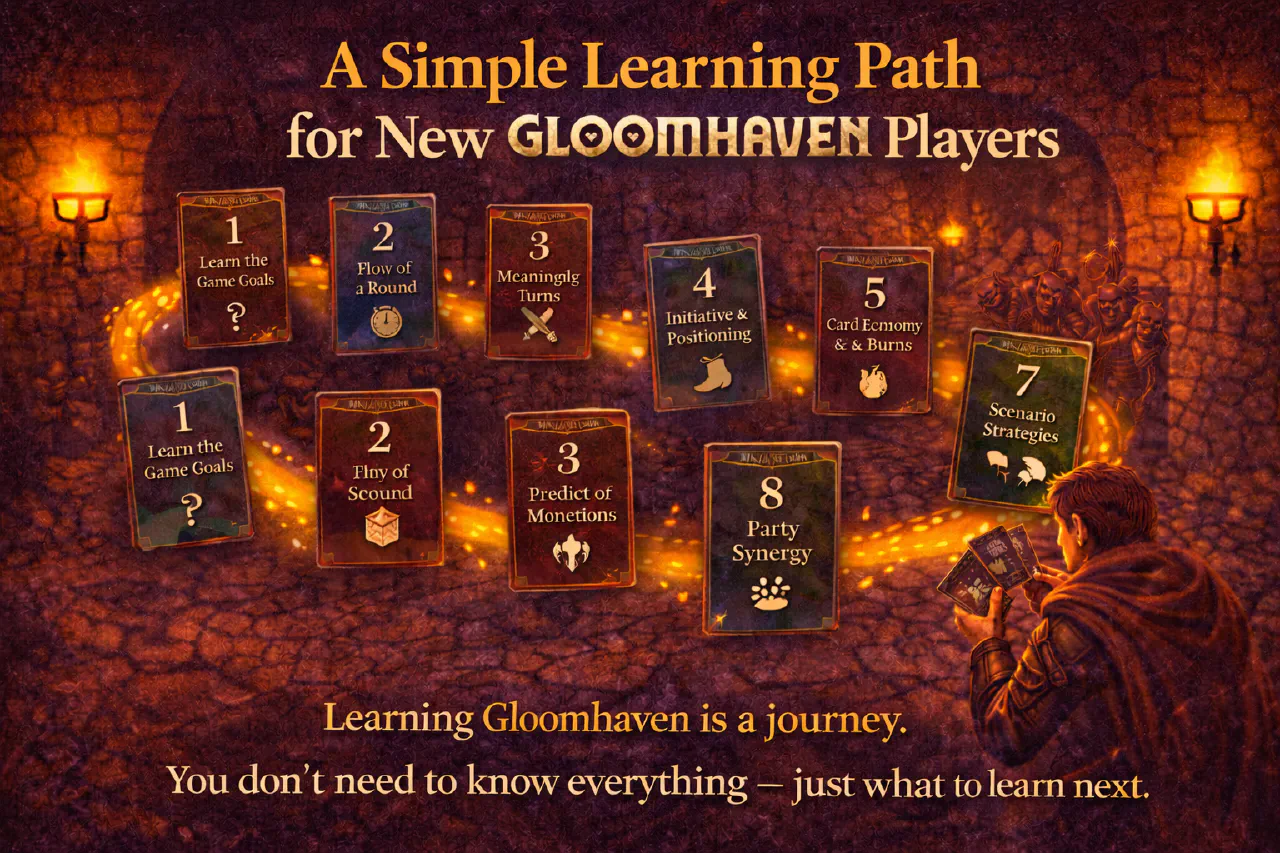
A Simple Learning Path for New Gloomhaven Players
A clear, beginner-friendly learning path for new Gloomhaven and Jaws of the Lion players, showing what to learn first, what to ignore early, and how the game clicks over time.
How Long a Scenario Really Takes (And Why)
Understand how long a Gloomhaven or Jaws of the Lion scenario actually takes, why early scenarios feel slow, and what factors most affect playtime at the table.
How to Choose Your First Character
A beginner-friendly guide to choosing your first character in Gloomhaven or Jaws of the Lion, focusing on playstyle, learning curve, party balance, and common beginner traps.