
On this page
Almost every Gloomhaven player — veterans included — will tell you roughly the same thing:
“I lost several scenarios before I finally understood how the game works.”*
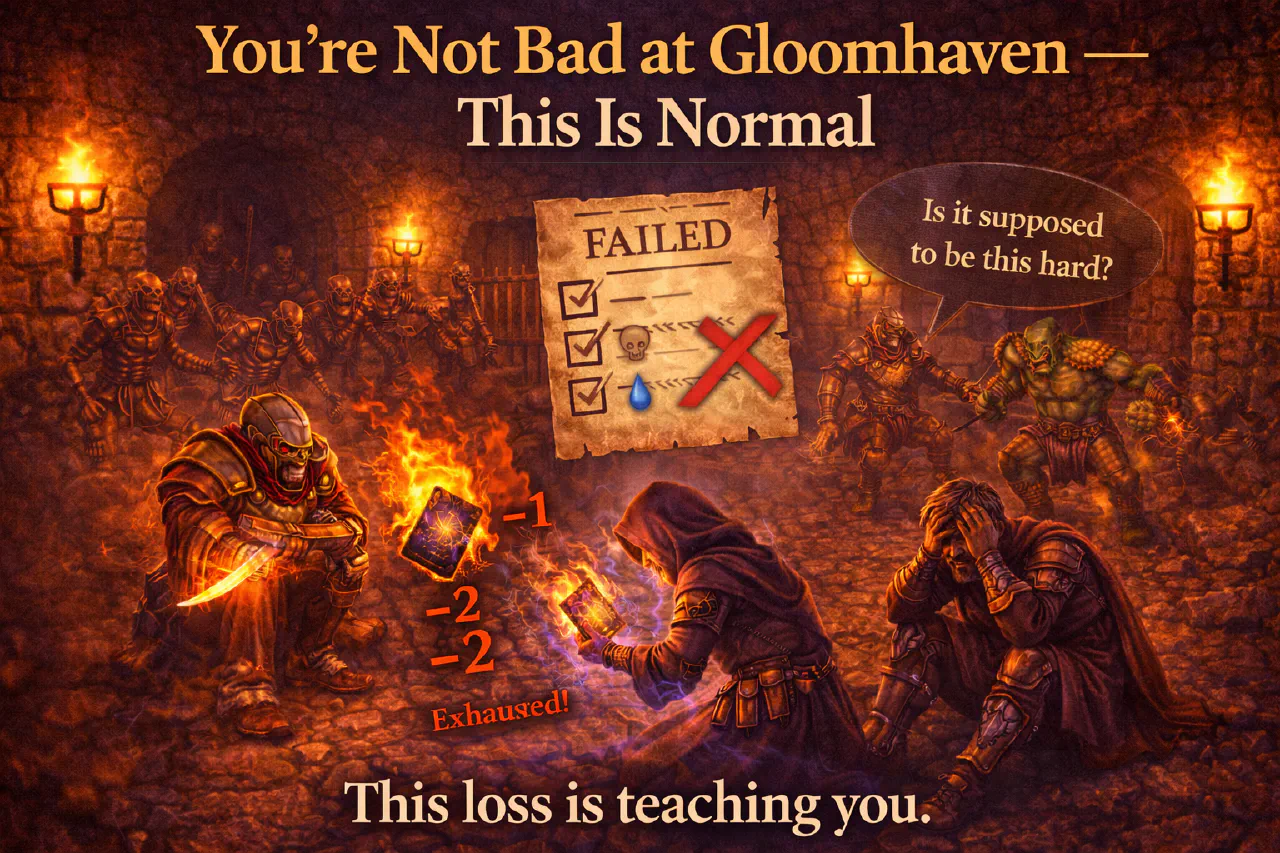
If you’re here because you lost a scenario despite playing carefully and following “correct” advice, take a breath. You’re not failing the game — you’re playing the game. Early losses are not only normal, they’re part of the designed learning process.
This article explains why Gloomhaven feels hard at first and why your early struggles are expected and valuable.
Gloomhaven Is a Game of Systems, Not Just Tactics
Gloomhaven isn’t a typical tactical board game — it’s a systems game layered on top of tactical choices.
At first, it feels like:
- You lose because the game is unfair
- The monsters are too strong
- Luck is beating you
- The scenario is impossible
But what’s really happening is that there are layers of interacting mechanics you don’t see at first:
- Initiative isn’t just “turn order” — it affects positioning and enemy engagement
- Cards aren’t just actions — they’re both movement and long-term stamina
- Monsters don’t act randomly — they follow predictable ability deck logic
That complexity doesn’t disappear — you learn to manage it. Early losses are simply evidence that you haven’t internalized these systems yet.
You’re Still Learning to Think Like the Game Thinks
Gloomhaven teaches its own language slowly, and early in a campaign you’re still translating.
New players often approach scenarios as if:
- Higher damage always matters most
- Clearing every enemy is the goal
- Healing prevents all losses
- Initiative is just “who goes first”
Once you learn:
- When movement matters more than damage
- How to prioritize threats
- When to let enemies come to you
- When to burn cards to win, not survive
…you stop feeling like the game “cheats.”
Your early losses are the price of learning that language.
The Game Isn’t Trying to Be Easy
Gloomhaven and Jaws of the Lion are among the most complex tabletop RPG-like systems around. The designers intentionally push players into:
- tough choices
- resource scarcity
- incomplete information
- imperfect attacks
- real risk
That means you don’t succeed by default — you succeed by improving, experimenting, and adapting.
Every loss teaches you something about:
- Initiative control
- Card economy
- Positioning
- Objective progression
- Time management
If there were no losses, there’d be no learning curve. The curve isn’t a flaw — it’s the point.
Early Losses Happen Even to Good Decisions
In your first few scenarios you might be doing all of the “right” steps:
- Holding choke points
- Prioritizing dangerous enemies
- Avoiding unnecessary fights
- Healing efficiently
- Managing initiative
…but still lose.
Why? Because Gloomhaven is not just about a single good decision — it’s about compounding decisions over many rounds under limited resources.
Even when your decisions are correct:
- A bad initiative order can punish you
- Monster cards can dictate weird movement patterns
- A single misstep in early turns can snowball
- You might misjudge enemy focus or pathing
That doesn’t mean you’re bad — it means the game rewards strategic foresight, not just moment-by-moment safety.
Loss Is Feedback, Not Failure
In Gloomhaven, losing a scenario isn’t a sign of weakness — it’s a feedback mechanism.
Each loss teaches you something you didn’t know:
- Where enemies spawn and move
- How monster initiative interacts with yours
- How to pace movement vs actions
- Which cards burn in which situations
- When to prioritize objectives over kills
Every experienced player has a list of scenarios they lost two or three times before winning — often because they had to learn key lessons through those defeats.
You’re Learning Odds and Patterns, Not Random Chaos
Monsters don’t act randomly — they follow ability cards with movement and attack patterns. New players often interpret unpredictable behavior as “bad luck,” but Gloomhaven’s challenge comes from learning and anticipating those patterns.
Once you internalize:
- how monsters pathfind
- how initiative values influence movement
- how ranged enemies choose targets
you start predicting enemy turns instead of reacting to them.
That’s where the game stops feeling swingy and starts feeling tactical.
Improvement Is Very Visible in Gloomhaven
The good news is that the learning curve in Gloomhaven is steep at first, then very visible:
You’ll notice that:
- you make fewer bad positioning choices
- you handle objectives without over-fighting
- you survive turns you previously couldn’t
- you start winning scenarios you lost before
That change is real and measurable. It’s not luck — it’s skill growth.
You’re Not Alone in Your Frustration
Ask around in forums, chats, and subreddit communities — you’ll see the same sentiment again and again:
“I lost my first X scenarios and then things finally clicked.”
“After a few defeats, I began to understand initiative and movement.”
“I thought the game was too hard — until I learned timing.”
None of those players were “bad.” They were learning the game’s language.
You are too.
Final Thought
Losing early scenarios in Gloomhaven doesn’t mean you’re playing wrong.
It means you are in the process of mastering a complex tactical ecosystem.
You don’t get good at Gloomhaven by avoiding loss — you get good by:
- losing consciously
- learning deliberately
- applying lessons next turn
So take heart: your losses are teaching you more than your wins ever will.
You’re not bad. You’re learning.
Next reads
Keep going with spoiler-light, practical guidance.
Why Killing Everything Is Often the Wrong Goal
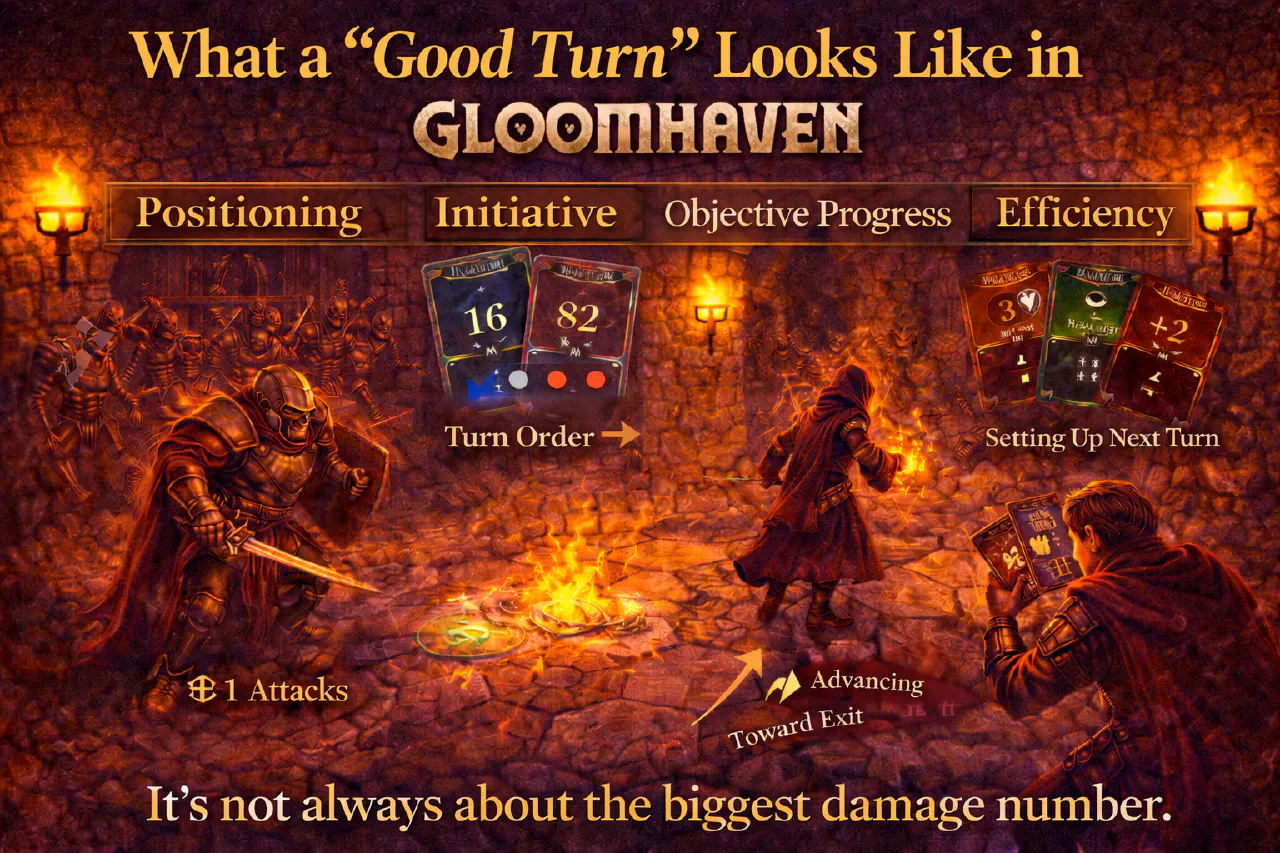
What a Good Turn Looks Like in Gloomhaven
A practical guide to understanding what makes a strong turn in Gloomhaven or Jaws of the Lion, focusing on progress, positioning, initiative, and efficiency rather than just damage.
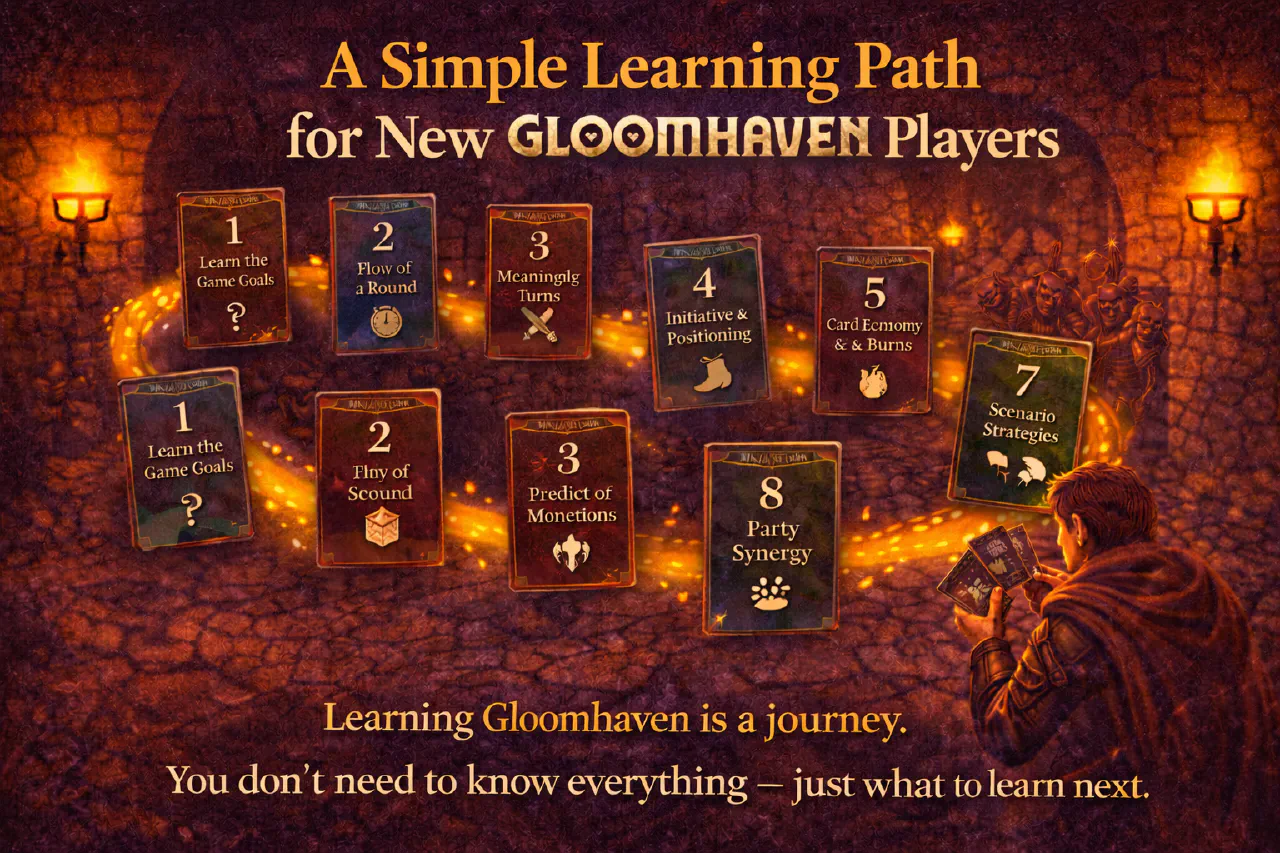
A Simple Learning Path for New Gloomhaven Players
A clear, beginner-friendly learning path for new Gloomhaven and Jaws of the Lion players, showing what to learn first, what to ignore early, and how the game clicks over time.
How Long a Scenario Really Takes (And Why)
Understand how long a Gloomhaven or Jaws of the Lion scenario actually takes, why early scenarios feel slow, and what factors most affect playtime at the table.
How to Choose Your First Character
A beginner-friendly guide to choosing your first character in Gloomhaven or Jaws of the Lion, focusing on playstyle, learning curve, party balance, and common beginner traps.