
On this page
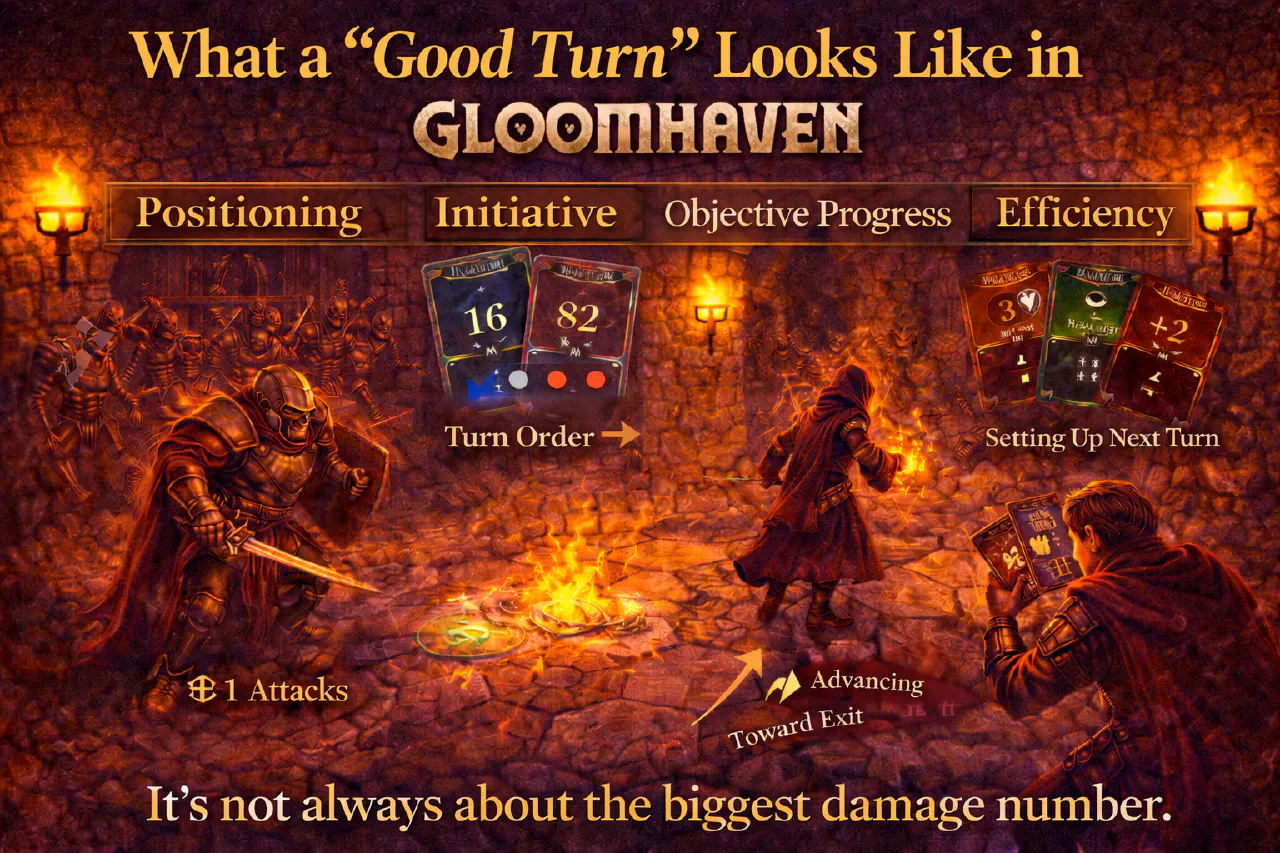
In Gloomhaven and Jaws of the Lion, success isn’t determined solely by who deals the most damage or survives the longest — it’s determined by how effectively each turn advances the party toward its objective. New players often measure success in the wrong ways: maximizing damage, avoiding hits, or clearing every monster in a room. While those can be part of a good turn, they’re not the core of what makes a turn truly effective.
This article explains how to evaluate a turn based on what really matters: progress, efficiency, positioning, and future options.
Progress Over Perfection
A good turn in Gloomhaven is not necessarily one where you kill enemies, even if it feels powerful. A good turn is one that advances the scenario’s objective while minimizing future risk.
Think of a turn as a unit of progress — a step forward on the scenario’s timeline. If your action moves you closer to your objective or strengthens your standing relative to the board state, it’s a good turn. If it just makes the board look cleaner, but doesn’t improve your ability to complete objectives, it might not be as good as it feels.
Four Pillars of a Good Turn
1. Positioning
Where you end your turn matters more than where you started it. Gloomhaven is fundamentally spatial: hex grids, line of sight, movement costs, control of choke points, and enemy placement all influence future turns.
Good positioning:
- Reduces incoming attacks on your party
- Aligns you with objectives or strategic spots
- Sets you up for stronger next turns
- Forces enemies into unfavorable positions
Bad positioning often leads to:
- Getting surrounded
- Wasting movement on later turns
- Losing tempo
2. Initiative Awareness
Initiative determines the order in which figures (players and monsters) act. A good turn takes initiative into account.
Choosing your initiative card isn’t just about who goes first; it’s about when you want your effects to resolve relative to enemy actions. For example:
- Acting early might let you move into a good position before monsters move.
- Acting late might let you react to monster movement and attacks.
A good turn picks initiative thoughtfully, rather than as an afterthought.
3. Objective Advancement
The scenario objective should be your north star, and each turn should contribute to moving toward it.
In Gloomhaven, objectives might include:
- Reaching an exit before a timer expires
- Surviving a certain number of rounds
- Protecting an objective against waves
- Activating specific tiles in sequence
A good turn advances you toward the objective, even if it doesn’t involve killing enemies. If your turn doesn’t make progress toward the scenario’s win condition, ask why you made the choices you did.
4. Efficiency of Resources
Your hand of ability cards is your core resource. Each card choice has a cost: potential future actions, stamina, movement, attacks, defense, and healing.
A good turn:
- Uses cards that provide the highest value per cost
- Avoids unnecessary burns
- Preserves options for upcoming turns
- Uses actions that benefit multiple characters when possible
Using a card to achieve a slight benefit now at the cost of future capability is a decision that should be intentional, not accidental.
What a Good Turn Isn’t
Understanding what a good turn isn’t can often be just as instructive.
A turn is not good simply because:
- You dealt the most damage
- You healed a character who wasn’t in danger
- You cleared a monster that wasn’t affecting your objective
- You prevented one point of damage when many are incoming
Those actions might be part of a good turn if they contribute to a larger purpose, but taken in isolation they’re only comfort moves — not progress.
Examples of Good vs. Common Turns
Example: Moving Toward the Objective
Scenario: You need to reach an exit within a certain number of rounds.
- Good turn: Move three hexes toward the exit and prepare a defensive position for the next round.
- Not as strong: Stay in place clearing weak enemies that don’t block your path.
Even if you didn’t deal damage, you advanced the objective — that’s a good turn.
Example: Positioning for Safety
Scenario: You’re near a doorway with several enemies approaching.
- Good turn: Move to a choke point, gain a shield effect, and ensure that your party can only be attacked by one enemy at a time.
- Not as strong: Move forward to attack a ranged enemy but get surrounded.
The first turn strengthens future turns; the second creates new vulnerabilities.
Example: Initiative Matters
Scenario: You and a monster both have movement cards.
- Good turn: Choose a slightly slower initiative that lets the monster move first into a suboptimal position, then reposition yourself advantageously.
- Not as strong: Always going early with no regard for enemy movement.
Your initiative choice should fit the broader strategy, not just the immediate action.
Team Coordination and Good Turns
In multiplayer scenarios, a good turn for the party isn’t always the same as a good turn for an individual. Coordination is key.
Good team turns:
- Combine movement, control, and attack in ways that protect the party’s larger plan
- Anticipate what allies will do next
- Avoid actions that make allies’ turns harder
Communication and foresight turn individual good turns into compound advantage.
The Slow Learning Curve
For new players, it’s natural to evaluate turns based on immediate tactical benefits: damage dealt, healing applied, enemy killed. But Gloomhaven is a game of compounding strategic advantages.
Over time, good turns will feel more natural. You’ll start to intuitively:
- anticipate monster behavior
- position for future rounds
- balance risk vs. progress
- use initiative to shape the board
Long before you master the depth, you’ll notice that your turns start looking smarter — not because you make fewer mistakes, but because you make more purposeful decisions.
Summary: What Makes a Turn Good
A good turn in Gloomhaven:
- Advances the scenario objective
- Improves positioning
- Uses initiative wisely
- Manages resources efficiently
- Supports the party’s long-term success
If your actions help the party get closer to winning while maintaining options for future turns, you just had a good turn — even if it didn’t look flashy.
Next reads
Keep going with spoiler-light, practical guidance.
Why Killing Everything Is Often the Wrong Goal
You’re Not Bad at Gloomhaven — This Is Normal
Why early losses in Gloomhaven and Jaws of the Lion are part of learning the game, what makes the game feel hard at first, and how your decisions actually matter more than luck.
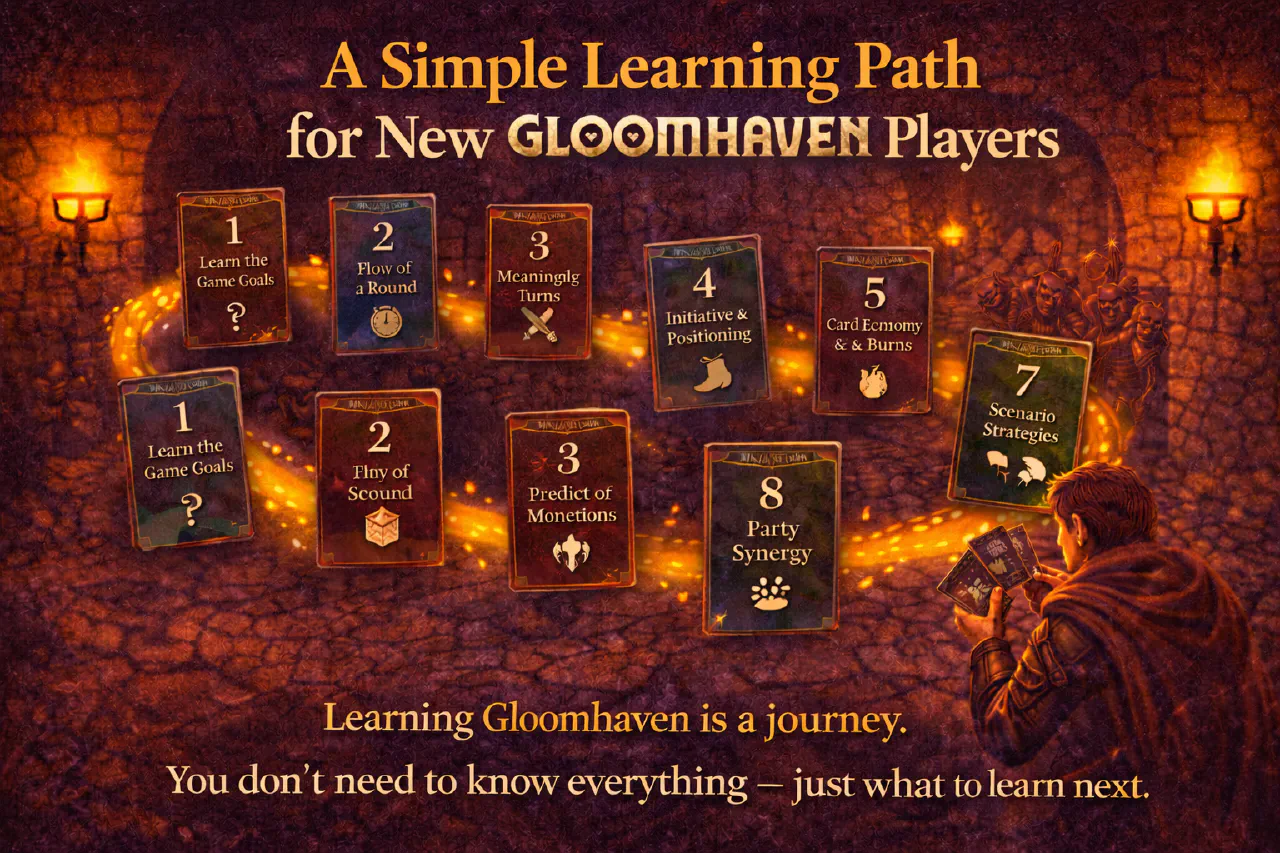
A Simple Learning Path for New Gloomhaven Players
A clear, beginner-friendly learning path for new Gloomhaven and Jaws of the Lion players, showing what to learn first, what to ignore early, and how the game clicks over time.
How Long a Scenario Really Takes (And Why)
Understand how long a Gloomhaven or Jaws of the Lion scenario actually takes, why early scenarios feel slow, and what factors most affect playtime at the table.
How to Choose Your First Character
A beginner-friendly guide to choosing your first character in Gloomhaven or Jaws of the Lion, focusing on playstyle, learning curve, party balance, and common beginner traps.