
On this page
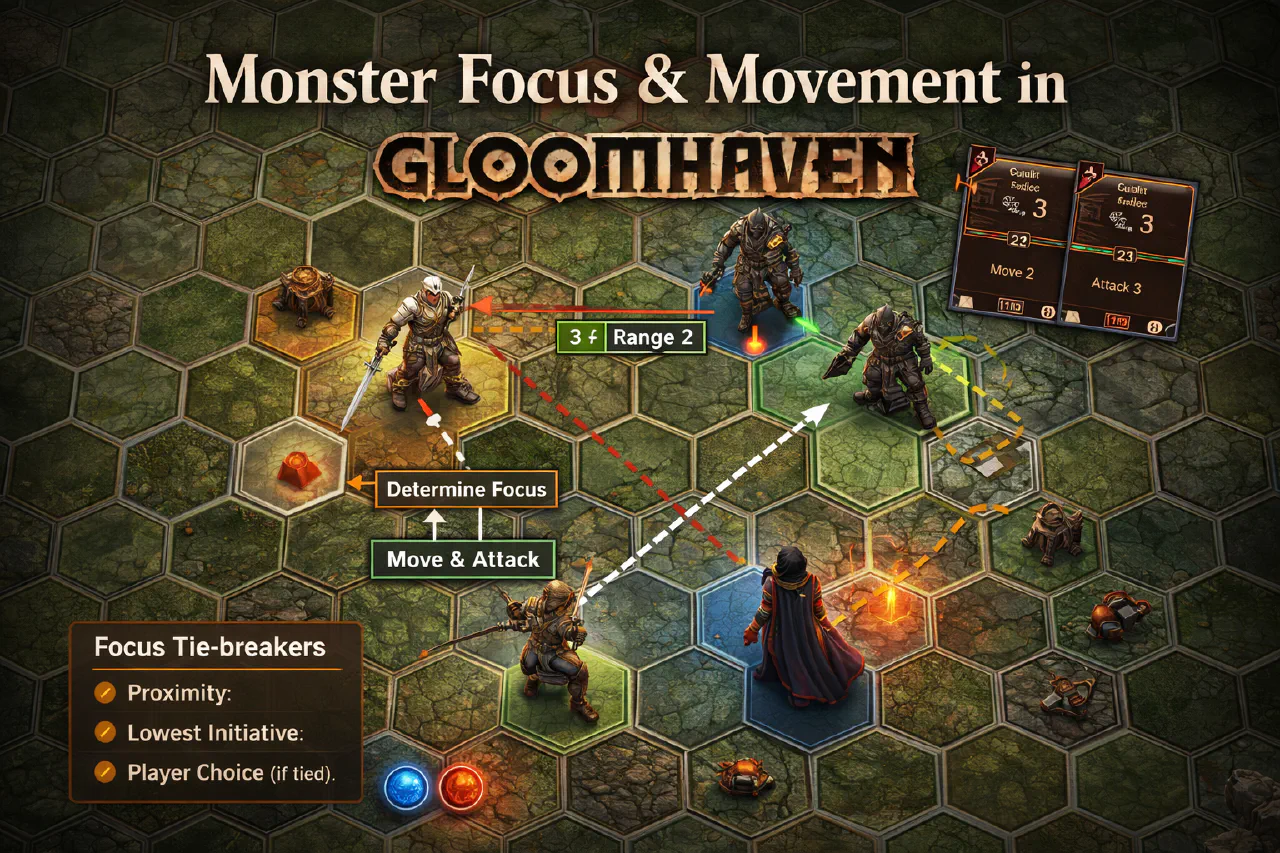
Monster movement is the most commonly misplayed rule in Gloomhaven — not because it’s random, but because it’s deterministic in a way that feels unintuitive at first.
The good news: once you learn the focus rules, monster turns become predictable, exploitable, and fast to resolve.
This guide explains:
- how monsters choose a focus
- how they decide where to move
- what monsters do not consider
- common mistakes new groups make
The One-Sentence Rule (Memorize This)
A monster focuses on the enemy it can reach and attack using the least total movement, even if it can’t reach that enemy this turn.
Everything else is a tie-breaker or consequence of that rule.
Step 1: Does the Monster Have an Attack This Turn?
Look at the monster’s ability card.
If the card includes an Attack
- Use that attack’s range when determining focus.
If the card does not include an Attack
- The monster still finds focus as if it were making a melee attack (range 1).
This surprises many players:
Monsters without an attack can still move aggressively toward you.
Step 2: Determine Potential Attack Hexes
For each enemy on the board, imagine:
- The monster has infinite movement
- It is trying to reach any hex from which it could attack that enemy
- That hex must satisfy:
- attack range
- line of sight
- normal movement rules (walls block, doors matter)
You are not asking “Can it attack now?”
You are asking:
“What is the minimum movement needed to ever attack this enemy?”
Step 3: Choose the Focus (Lowest Required Movement)
Whichever enemy requires the least movement to reach a valid attack hex becomes the monster’s focus.
Important clarifications:
- It does not matter if the monster cannot reach that hex this round.
- It does not matter if another enemy is physically closer.
- Focus is about path length to attack, not distance.
Step 4: Tie-Breakers (In Order)
If multiple enemies are tied for lowest movement required:
-
Proximity
The enemy physically closest (counting hex distance, respecting walls). -
Initiative
If still tied, the enemy with the lower initiative this round.
If it is still ambiguous, players may choose — always resolve ambiguity in the players’ favor.
Step 5: Monster Movement
Once focus is chosen, the monster moves:
- Only as much as needed
- Along the shortest path
- Toward the best possible attack hex
Monsters do not:
- move their full movement if unnecessary
- reposition “just because”
- optimize future turns beyond the current attack
If the monster can already attack from its current hex, it does not move at all.
Step 6: Attack (If Possible)
After movement:
- If the monster has range and line of sight to its focus → it attacks.
- If not → its turn ends.
Movement never happens after attacking unless the card explicitly says so.
What Monsters Do NOT Consider (Very Important)
Disadvantage
Monsters ignore disadvantage when choosing focus.
A ranged monster adjacent to a player will still focus that player, even though the attack will be disadvantaged. If the monster has movement before they attack, they will move the minimum amount needed to lose disadvantage on that target before attacking.
Traps (Usually)
Monsters treat traps and hazardous terrain as worse than normal hexes, but:
- They prefer any safe path, no matter how long
- Over a shorter path that includes a trap
They will only step on traps if no safe path exists to attack any enemy.
Player Intent
Monsters do not “avoid tanks,” “go after squishy characters,” or “play smart.”
They follow the rules. Every time.
Common Examples
Example 1: “That monster can’t reach me this turn”
Doesn’t matter.
If the path to attack you is shorter than the path to attack someone else, you are the focus, even if the monster won’t reach you this round.
Example 2: Ranged monster next to a player
The adjacent player is the focus.
After that:
- If the monster can move 1 hex and still attack its focus without disadvantage, it will.
- If not, it stays and attacks with disadvantage.
Example 3: Two targets, same distance
Use proximity → then initiative.
Distance to attack hex always comes first.
When Monsters Don’t Move
A monster will not move if:
- its card has no Move
- moving wouldn’t improve its attack
- it is already in its best possible attack hex
This often makes monsters look “lazy,” but they are behaving correctly.
- Ignoring infinite-movement focus logic
- Moving monsters farther than necessary
- Letting monsters avoid traps strategically
- Re-evaluating focus after partial movement
- Does it have an attack? If no, pretend melee.
- Find shortest path to any hex where it could attack an enemy.
- Lowest movement = focus.
- Tie-breakers: proximity → initiative.
- Move only as much as needed.
- Attack if possible.
Why This Rule Exists
Gloomhaven monsters are designed to be:
- predictable
- fast to run
- tactically exploitable
Once your table understands focus, monster turns become the easiest part of the game, not the hardest.
Next reads
Keep going with spoiler-light, practical guidance.
Why Killing Everything Is Often the Wrong Goal
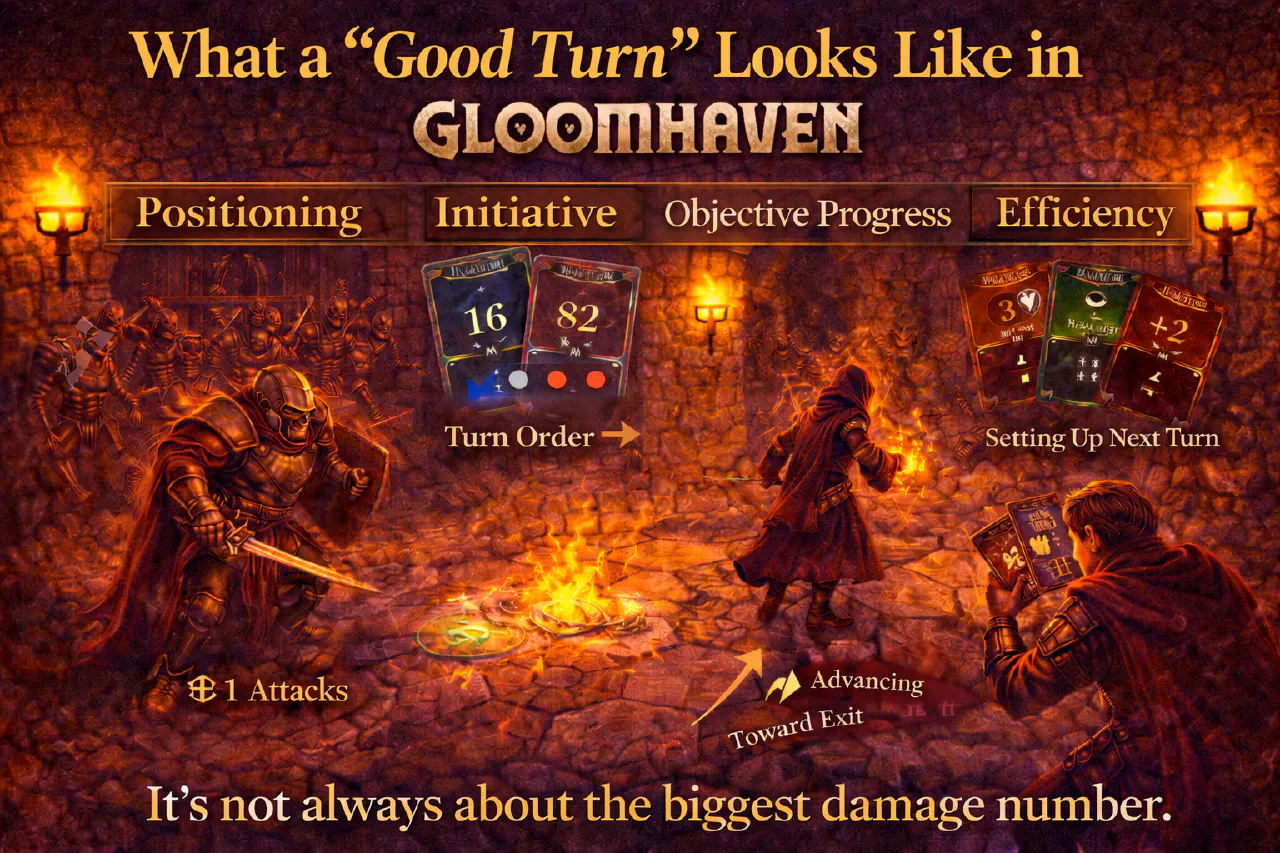
What a Good Turn Looks Like in Gloomhaven
A practical guide to understanding what makes a strong turn in Gloomhaven or Jaws of the Lion, focusing on progress, positioning, initiative, and efficiency rather than just damage.
You’re Not Bad at Gloomhaven — This Is Normal
Why early losses in Gloomhaven and Jaws of the Lion are part of learning the game, what makes the game feel hard at first, and how your decisions actually matter more than luck.
A Simple Learning Path for New Gloomhaven Players
A clear, beginner-friendly learning path for new Gloomhaven and Jaws of the Lion players, showing what to learn first, what to ignore early, and how the game clicks over time.
How Long a Scenario Really Takes (And Why)
Understand how long a Gloomhaven or Jaws of the Lion scenario actually takes, why early scenarios feel slow, and what factors most affect playtime at the table.
How to Choose Your First Character
A beginner-friendly guide to choosing your first character in Gloomhaven or Jaws of the Lion, focusing on playstyle, learning curve, party balance, and common beginner traps.