
On this page
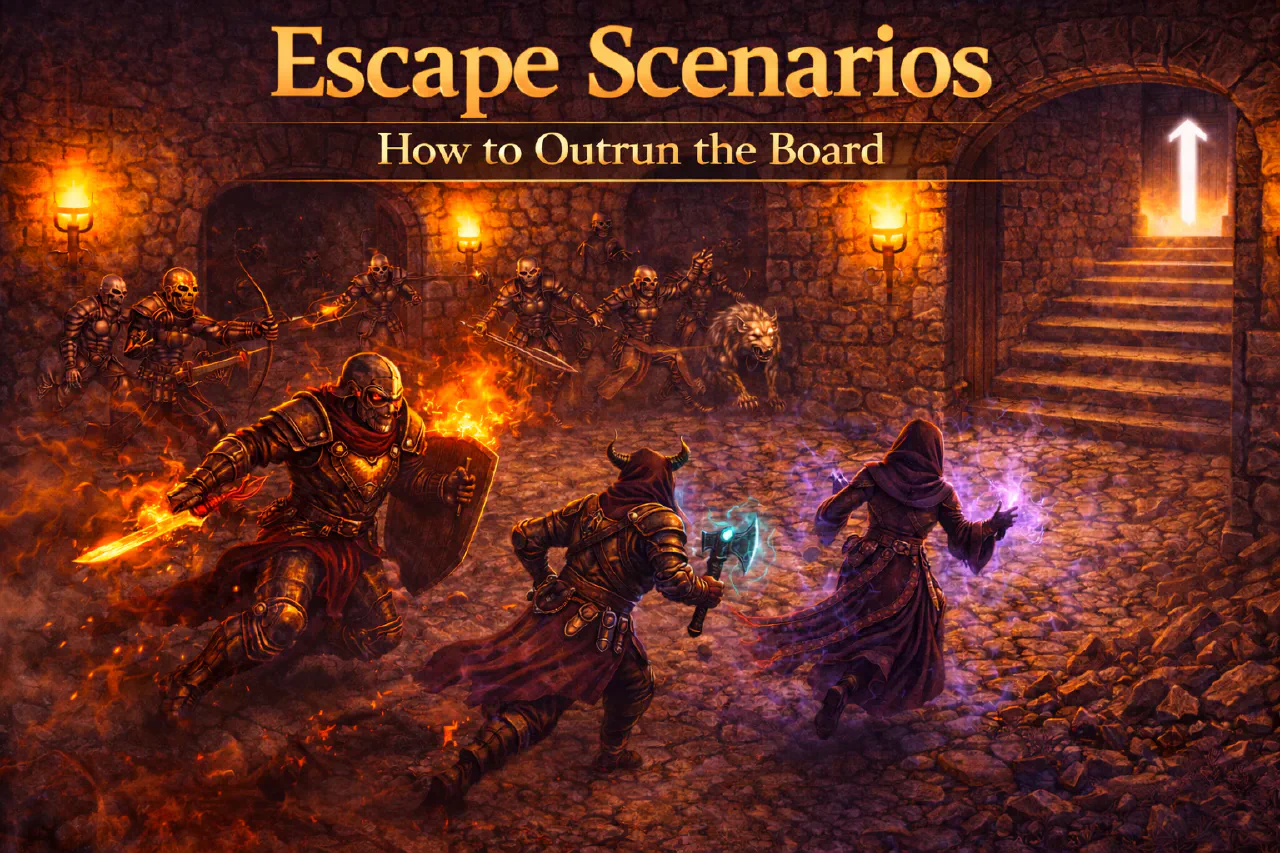
In Gloomhaven and Jaws of the Lion, not every scenario is about defeating all enemies. Some are about surviving to a specified exit, outrunning spawning threats, or reaching a tile before enemies can overwhelm you.
These types of scenarios — often called escape scenarios or sprint objectives — require a different mindset than standard “clear the room” fights. Instead of grinding down every monster, you’re optimizing movement, initiative, and risk to finish the objective before the board overwhelms you.
This guide will help you think like a sprinter, not a grinder.
Understanding What “Escape” Means
In escape or exit-focused scenarios, the scenario is completed when:
- Every character is standing on the exit hex specified by the scenario rules.
- Characters who are exhausted while on an exit hex still count toward completion.
- The moment the last required character occupies the exit hex, the party wins.
This is how many “escape” scenarios are intended to work in base Gloomhaven and its expansions like Jaws of the Lion.
Shift in Priorities: Movement > Combat
In a typical combat scenario, your first instinct might be to maximize damage or hold ground. In escape scenarios, that mindset often gets you killed.
The priority shifts to:
- Getting to the exit efficiently
- Avoiding unnecessary combat
- Using actions that help reposition or delay enemy aggression
- Using terrain and initiative to buy time
You do not need to kill everything. You need to reach the exit before you’re overwhelmed.
Know the Enemy Spawn and Movement Patterns
Most escape scenarios feature:
- Monsters that spawn repeatedly until a condition is met
- Monsters that move slowly toward your party
- Enemies that don’t run away or reposition
Understanding these patterns is vital:
- Monsters don’t always move aggressively; they move based on their AI priority (path toward a target).
- Slow monsters can sometimes be outrun entirely with careful planning.
- Fast movers and ranged attackers often dictate whether you can safely sprint or must delay (e.g., stay out of range or funnel them).
Movement First: Tools That Matter Most
In escape scenarios, movement becomes your strongest tool — often stronger than attack.
Things that help:
- Cards with high movement values
- Cards that combine movement + attack
- Team coordination (pass movement or reposition abilities)
- Items that boost speed (Boots, Potions, etc.)
Rather than focusing on killing a monster, you should value:
- Being able to reach the exit tile quickly
- Staying ahead of the monster threat front
- Redirecting enemy attention with minimal investment
Initiative Strategy for Escape Scenarios
In traditional clearing scenarios, initiative can be flexible. In escape scenarios, it’s critical.
When to Go Early
- If you need to close distance toward the exit
- If you want to block enemy advance
- If you’re trying to gain a positional advantage
When to Go Late
- If enemies move faster than you and you want them to pass their turn first
- If moving late lets you avoid movement before your targeted turn
- To extend the time of invisibility
Initiative swings matter more here because they determine how much ground you can cover relative to approaching threats.
Avoid Unnecessary Fights
While it can feel satisfying to engage every enemy, escape scenarios punish this:
- Fighting every monster burns precious time.
- Monsters become more numerous the longer you stay.
- Objectives like reaching an exit are time-gated by enemy movement.
A useful principle is:
Only fight monsters that block your progress or pose a direct threat.
If a monster is in your way and must be removed for you to proceed, prioritize it. Otherwise, stride past threats that don’t impede your path.
Use Terrain to Delay Enemies
When you can’t outrun foes completely, terrain becomes your ally:
- Bottleneck enemies in doorways or narrow corridors.
- Lead enemies into difficult terrain that slows them down relative to you.
- Use obstacles and zones to break line of sight and force detours.
Delaying enemies gives you precious turns to push forward while they struggle to close distance.
Co-Ordinate Party Movement
Escape scenarios are team puzzles.
- Synchronize movement so characters reach the exit in waves.
- Use tank characters to keep pressure off ranged ones, while the range ones deal damage as they run.
- Have slower characters use movement cards early to avoid falling behind.
By spacing movement and combat roles effectively, you buy time and reduce wasted turns.
Know When to Sacrifice Cards
Escape scenarios often push characters close to exhaustion as they burn cards to move quickly. This is acceptable if:
- The sacrifice shortens the time to reach the exit
- The scenario will complete before exhaustion collapses the party
- You’ve coordinated card plays so that key actions still occur when needed
In other words: don’t be afraid to trade HP or cards strategically when it accelerates your escape.
Scenario Objectives Matter
Always read the scenario goal carefully: the exit condition might be:
- Reach a specific tile
- End your turn on exit tiles
- Complete a separate objective before exiting
Since objectives vary slightly by scenario, knowing exactly what constitutes success can influence your path and card use drastically.
For example:
- Some escape scenarios require all characters to exit.
- Some allow characters to exit one at a time as long as they survive.
- Some even allow exit upon exhaustion on the exit hex.
Understanding these clauses is essential to intelligent planning.
When It’s Better to Fight
There are cases where slowing enemies with attacks can actually help your escape:
- If attacking one enemy delays its turn and keeps it out of range for one more turn
- If certain monsters can spawn reinforcements
- If a particular enemy’s ability fundamentally blocks advancement
In those cases, use minimal, efficient attacks that either reposition or delay, rather than attempting to clear entire groups.
Practical Tips Summary
- Prioritize movement and positioning over combat
- Know how enemy movement compares to yours — outrunning means staying ahead of their approach range
- Use initiative tactically to cover more distance or delay threats
- Avoid unnecessary fights
- Use terrain to slow enemies
- Coordinate party movement
- Understand the exact exit condition
- Don’t be afraid to use cards and HP to accelerate progress
Final Thoughts
Escape scenarios are exciting because they turn Gloomhaven from a tactical brawler into a strategic race against the board.
They reward:
- Good planning
- Smart card selection
- Optimal initiative timing
- Creative use of terrain and enemy manipulation
If you approach them with the right mindset — movement first, combat as a tool, not a goal — you’ll find yourself winning these sprint scenarios far more consistently.
Next reads
Keep going with spoiler-light, practical guidance.
Why Positioning Matters More Than Damage
Learn why positioning is often more important than raw damage in Gloomhaven and Jaws of the Lion. A beginner-friendly guide to safer turns, better movement, and smarter scenario play.
Stop Healing So Much
Healing feels safe in Gloomhaven, but it can quietly cost you scenarios. Learn when healing is worth it, when it wastes tempo, and why preventing damage is usually stronger.
Running Out of Cards in Gloomhaven? Exhaustion and Card Management
Learn why you exhaust in Gloomhaven and Jaws of the Lion, how early loss cards reduce your turns, and how to finish scenarios with better card management.
How to Win Scenarios With Tight Time Limits
Practical strategies for beating time-limited scenarios in Gloomhaven and Jaws of the Lion. Learn pacing, card management, initiative control, and when to push instead of fight.
Split-Party Scenarios: Stay Alive While Divided
How to survive split-party scenarios in Gloomhaven and Jaws of the Lion. Learn role assignment, pacing, initiative control, and regrouping tactics to avoid getting overwhelmed.
Why You’re Losing Scenarios Even When Playing ‘Correctly’
Explore common hidden reasons players lose Gloomhaven and Jaws of the Lion scenarios despite thinking they are playing correctly. Learn tactical, strategic, and game-mechanic blind spots that often determine losses.