
On this page
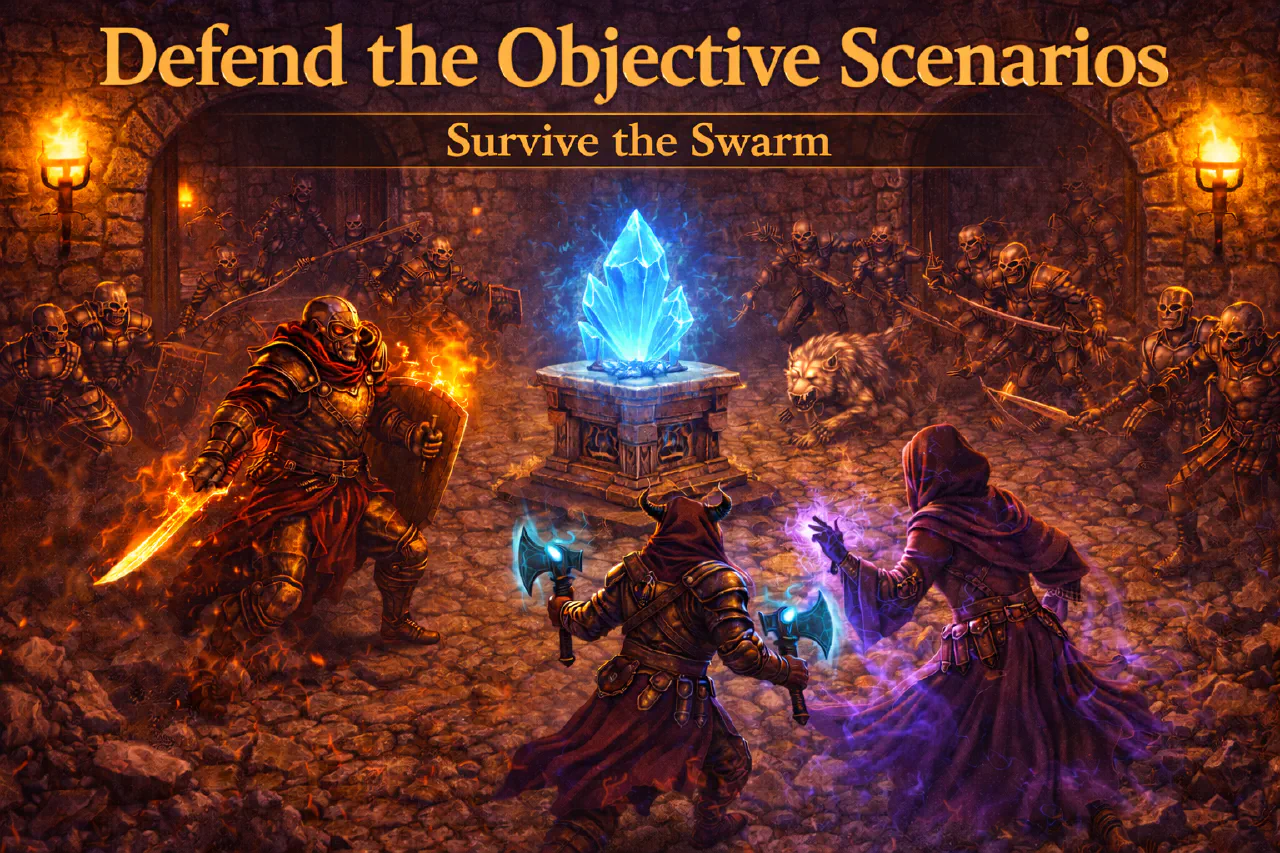
Defend-the-objective scenarios are some of the most stressful — and misunderstood — scenario types in Gloomhaven and Jaws of the Lion. Instead of pushing forward or racing the clock, your party must hold ground, withstand repeated attacks, and protect something that cannot move or fight back.
Many losses in these scenarios happen not because of bad luck, but because players approach them like standard combat encounters. To survive the swarm, you need to change how you think about damage, positioning, and time.
This guide explains how to do exactly that.
What Makes Defend Scenarios Different
In defend-the-objective scenarios, the goal is usually one of the following:
- Prevent an objective (altar, device, NPC, location) from being destroyed
- Survive a fixed number of rounds
- Hold an area while enemies spawn or advance
Unlike typical scenarios:
- You cannot retreat
- Enemies often outnumber you
- Spawns may be infinite or timed
- Killing everything is usually impossible or unnecessary
Success depends on damage control and endurance, not speed or total kills.
Core Mindset Shift: Control > Damage
In defend scenarios, raw damage is less important than:
- Reducing the number of attacks per round
- Controlling where enemies can stand
- Preventing enemies from reaching the objective
- Stretching your cards as long as possible
Think less about “How do we kill these enemies?”
Think more about “How do we stop them from acting effectively?”
Positioning Is the Real Objective
Where you stand matters more than what you hit.
Protect the Objective, Not the Map
Your goal is not to dominate the entire room — it’s to control the approaches to the objective.
Effective positioning usually means:
- Standing between enemies and the objective
- Using walls, obstacles, and doorways as funnels
- Forcing enemies to take inefficient paths
If an enemy can’t reach the objective, it might as well not exist.
Create and Hold Choke Points
Defend scenarios reward tight defensive lines.
Choke points:
- Limit how many enemies can attack at once
- Reduce the value of enemy numbers
- Make healing and shielding more efficient
Ideal defensive setups often involve:
- One or two characters holding a narrow approach
- Ranged characters operating safely behind them
- Control effects applied where enemies must pass
Avoid spreading out unless the scenario explicitly requires it.
Target Priority: Who Actually Matters?
Not all enemies are equal threats in defend scenarios.
High-Priority Targets
- Enemies that can damage the objective directly
- Ranged enemies that bypass your frontline
- Fast enemies that can slip past defenders
- Monsters with multi-target attacks
Lower-Priority Targets
- Slow melee enemies stuck behind others
- Enemies far from the objective
- Monsters blocked by terrain or positioning
You don’t need to kill everything — you need to kill the right things.
Damage Prevention Beats Healing
Healing is useful, but it is reactive and inefficient compared to prevention.
In defend scenarios, prioritize:
- Shield and damage reduction
- Disarm, Immobilize, and Stun
- Forced movement that pulls enemies away from the objective
- Initiative control that makes enemies waste turns
Every prevented attack is better than healing after the fact.
Initiative Control Is Critical
Defend scenarios often punish poor initiative choices.
When to Act Early
- To block enemy movement
- To apply control before enemies attack
- To reposition into defensive formations
When to Act Late
- To let enemies move into choke points
- To bait enemies into inefficient positions
- To avoid unnecessary movement or exposure
Smart initiative usage can reduce the number of effective enemy attacks by half or more.
Managing Endless or Timed Spawns
Some defend scenarios spawn enemies every round or on a timer.
Key principles:
- Do not chase spawns unless they threaten the objective
- Focus on holding territory, not clearing rooms
- Accept that some enemies will remain alive
- Preserve cards and stamina over damage output
If enemies spawn infinitely, the scenario is not about winning fights — it’s about lasting long enough.
Card Longevity and Burn Discipline
Defend scenarios often last longer than standard fights.
This makes card management crucial:
- Avoid burning cards early unless they dramatically reduce pressure
- Save loss actions for moments when the objective is truly threatened
- Use non-loss control and shield actions as your backbone
A single early burn can shorten your effective defense by multiple rounds.
Class Roles in Defend Scenarios
While every party is different, defend scenarios often benefit from clear role division:
- Frontliners: Hold choke points, soak attacks, apply control
- Ranged damage dealers: Eliminate high-priority threats
- Support characters: Heal, shield, debuff, and stabilize
- Control specialists: Slow or redirect enemies
Trying to have everyone do everything usually weakens the defense.
Common Mistakes That Lose Defend Scenarios
- Overextending to kill enemies that aren’t threatening the objective
- Leaving the objective undefended to chase spawns
- Burning cards too early for comfort damage
- Ignoring ranged enemies while tanking melee
- Spreading the party too thin
Most defeats come from abandoning defensive discipline.
When It’s Right to Go on the Offensive
There are moments when pushing forward makes sense:
- To eliminate a dangerous ranged enemy
- To destroy a spawn source if allowed
- To reposition before a major wave arrives
The key is intent:
If attacking reduces pressure on the objective, it’s correct.
If it only feels satisfying, it’s probably wrong.
Final Takeaway
Defend-the-objective scenarios are endurance tests, not damage races.
If you remember one principle, remember this:
You don’t win by killing everything. You win by making enemy turns inefficient until the scenario ends.
Master choke points, control initiative, prioritize the right threats, and protect the objective at all costs — and even the largest swarms become manageable.
Next reads
Keep going with spoiler-light, practical guidance.
Why Positioning Matters More Than Damage
Learn why positioning is often more important than raw damage in Gloomhaven and Jaws of the Lion. A beginner-friendly guide to safer turns, better movement, and smarter scenario play.
Stop Healing So Much
Healing feels safe in Gloomhaven, but it can quietly cost you scenarios. Learn when healing is worth it, when it wastes tempo, and why preventing damage is usually stronger.
Running Out of Cards in Gloomhaven? Exhaustion and Card Management
Learn why you exhaust in Gloomhaven and Jaws of the Lion, how early loss cards reduce your turns, and how to finish scenarios with better card management.
How to Win Scenarios With Tight Time Limits
Practical strategies for beating time-limited scenarios in Gloomhaven and Jaws of the Lion. Learn pacing, card management, initiative control, and when to push instead of fight.
Split-Party Scenarios: Stay Alive While Divided
How to survive split-party scenarios in Gloomhaven and Jaws of the Lion. Learn role assignment, pacing, initiative control, and regrouping tactics to avoid getting overwhelmed.
Why You’re Losing Scenarios Even When Playing ‘Correctly’
Explore common hidden reasons players lose Gloomhaven and Jaws of the Lion scenarios despite thinking they are playing correctly. Learn tactical, strategic, and game-mechanic blind spots that often determine losses.