
On this page
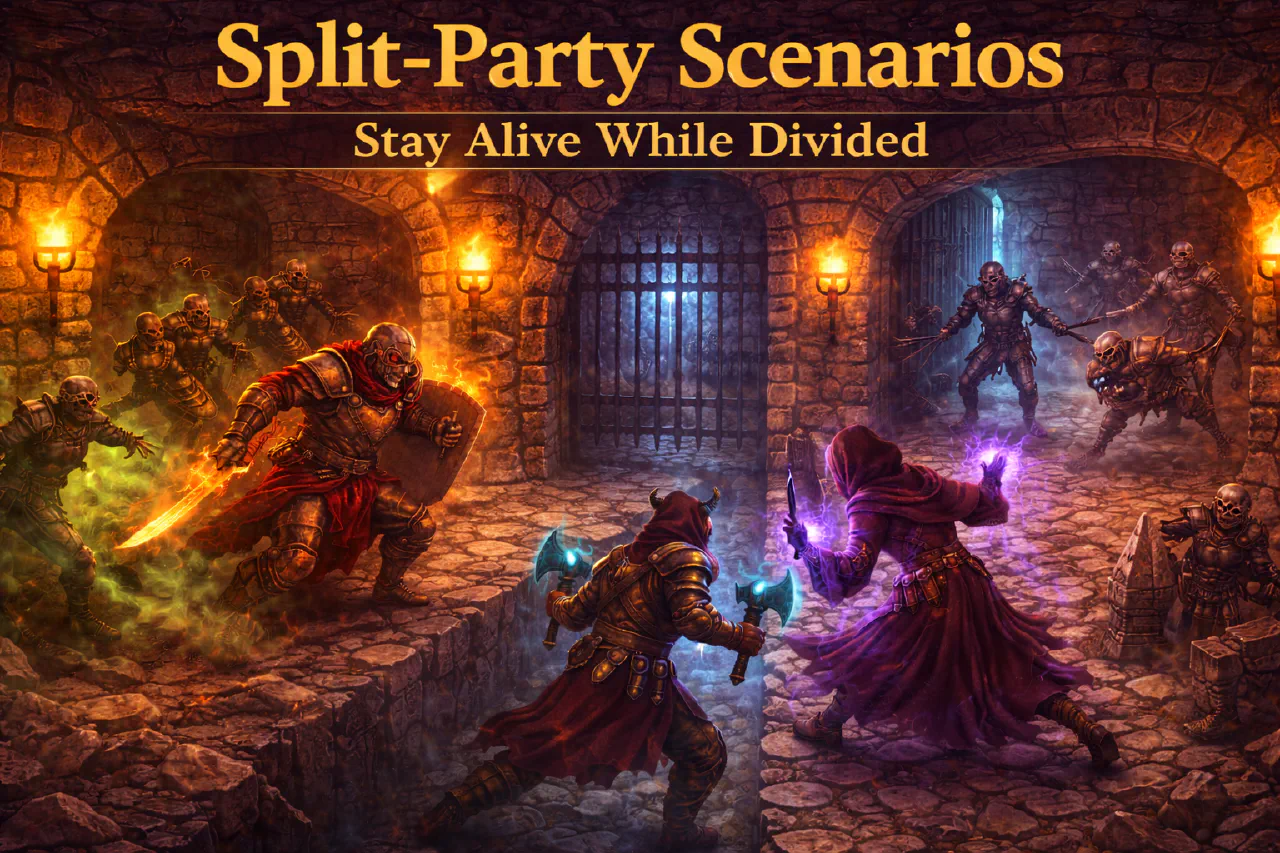
Split-party scenarios are some of the most dangerous and misunderstood challenges in Gloomhaven and Jaws of the Lion. Whether the map forces your group apart or the objective encourages multiple paths, dividing the party removes the game’s biggest safety net: concentrated strength.
Most losses in split-party scenarios happen because groups play them like normal scenarios — spreading out without a plan and trusting that “it will probably be fine.”
It usually isn’t.
This guide explains how to divide intentionally, survive early pressure, and regroup before the scenario collapses.
Why Split-Party Scenarios Are So Dangerous
When your party is divided:
- Healing is limited or unavailable
- Damage is harder to focus
- Control effects lose efficiency
- One bad initiative draw can cascade into exhaustion
Enemies don’t scale down just because you’re separated. A group of two characters facing a full room of enemies is often in more danger than four characters facing two rooms together.
The core challenge is not fighting, it’s survivability under isolation.
First Rule: Decide the Split Before the Scenario Starts
Never “accidentally” split the party.
Before the first round:
- Identify where the split occurs
- Decide who goes where
- Agree on when and how you’ll regroup
If you don’t do this upfront, the scenario will decide for you — and it will not be kind.
Assign Roles, Not Just Paths
Each subgroup should have a clear purpose.
Strong subgroup compositions usually include:
- Someone who can take hits
- Someone who can deal reliable damage
- Someone who can control or reposition enemies
Weak subgroup compositions often look like:
- Two fragile characters with no healing
- Two slow melee characters chasing ranged enemies
- A support character with no one to support
You are not splitting characters — you are splitting capabilities.
Balance Strength, Not Equality
The two sides do not need to be equal.
In fact, they often shouldn’t be.
Consider:
- One side may face heavier resistance
- One side may be time-gated
- One side may only need to delay, not win
It’s usually correct to send a stronger subgroup into the more dangerous area while a lighter group handles objectives or stalls.
Early Survival Matters More Than Speed
The most dangerous rounds in split-party scenarios are the first three.
Why:
- Characters haven’t positioned yet
- Initiative coordination is limited
- Healing and control haven’t stabilized
Early goals should be:
- Avoid card losses
- Avoid being surrounded
- Avoid unnecessary burns
Surviving intact is more important than advancing quickly.
Initiative Discipline Is Mandatory
Initiative mistakes are far more punishing when divided.
Key principles:
- Avoid going late if it exposes you to multiple attacks
- Avoid going early if it puts you alone in enemy range
- Use initiative to force enemies to move inefficiently
When split, every character should ask: “Can I survive the enemy turn if I stand here?”
If the answer is no, change your plan.
Do Not Chase Kills
Split-party scenarios punish greed.
Common losing behavior:
- Chasing one enemy into open space
- Advancing just to finish a kill
- Overextending to “help” the other group
Instead:
- Let enemies come to you
- Hold defensible positions
- Kill only what threatens your survival or blocks progress
You are buying time, not clearing the board.
Control and Delay Are More Valuable Than Damage
When divided, raw damage is less valuable than:
- Immobilize
- Stun
- Disarm
- Forced movement
- Terrain manipulation
A delayed enemy is often better than a damaged one, because delay:
- Buys turns
- Reduces incoming attacks
- Preserves stamina
Think in terms of time gained, not HP removed.
Know When to Regroup
Most split-party scenarios are not meant to stay split forever.
Watch for signs it’s time to regroup:
- One side has stabilized
- One side is running low on cards
- Objectives have been partially completed
- Enemy pressure is increasing faster than you can manage
Regrouping often turns a failing scenario into a winning one.
Regrouping Safely
Rejoining is often the most dangerous moment.
Tips for safe regrouping:
- Move late so enemies act first
- Clear or block choke points
- Avoid opening new rooms mid-regroup
- Ensure both sides arrive within one round of each other
Common Mistakes That Lose Split-Party Scenarios
- Splitting without a plan
- Sending two fragile characters together
- Overcommitting early for damage
- Ignoring initiative order
- Failing to regroup when pressure builds
- Burning cards to “catch up”
Most losses are slow collapses, not sudden wipes.
When Splitting Is Actually an Advantage
Some scenarios reward controlled division:
- Parallel objectives
- Pressure valves that must be handled simultaneously
- Timed mechanisms
In these cases, splitting works because:
- The scenario expects coordination
- Each side has a defined task
- Progress reduces overall pressure
The difference is intentional design, not improvisation.
Final Takeaway
Split-party scenarios are survival puzzles.
If you remember one thing, remember this:
You don’t win split-party scenarios by being fast — you win by staying alive long enough to reunite.
Plan the split, balance capabilities, protect stamina, and regroup deliberately. Do that, and even the most intimidating divided scenarios become manageable.
Next reads
Keep going with spoiler-light, practical guidance.
Why Positioning Matters More Than Damage
Learn why positioning is often more important than raw damage in Gloomhaven and Jaws of the Lion. A beginner-friendly guide to safer turns, better movement, and smarter scenario play.
Stop Healing So Much
Healing feels safe in Gloomhaven, but it can quietly cost you scenarios. Learn when healing is worth it, when it wastes tempo, and why preventing damage is usually stronger.
Running Out of Cards in Gloomhaven? Exhaustion and Card Management
Learn why you exhaust in Gloomhaven and Jaws of the Lion, how early loss cards reduce your turns, and how to finish scenarios with better card management.
How to Win Scenarios With Tight Time Limits
Practical strategies for beating time-limited scenarios in Gloomhaven and Jaws of the Lion. Learn pacing, card management, initiative control, and when to push instead of fight.
Why You’re Losing Scenarios Even When Playing ‘Correctly’
Explore common hidden reasons players lose Gloomhaven and Jaws of the Lion scenarios despite thinking they are playing correctly. Learn tactical, strategic, and game-mechanic blind spots that often determine losses.