
On this page
How to Win Scenarios With Tight Time Limits
Time-limited scenarios are some of the most punishing in Gloomhaven and Jaws of the Lion. Whether the objective is “complete within X rounds,” “before reinforcements overwhelm you,” or “reach the goal before exhaustion,” these scenarios demand a different mindset than standard dungeon crawls.
Many groups lose these scenarios not because they play poorly but because they play too carefully.
This guide explains how to adjust your strategy, pacing, and card usage to win scenarios where the clock is the real enemy.
The Core Problem: Time Is a Resource
In time-limited scenarios, rounds are a finite resource, just like cards and hit points.
Every round you spend:
- repositioning unnecessarily
- fighting enemies you don’t need to fight
- healing damage that could have been avoided
…is a round you cannot get back.
Winning these scenarios requires you to treat time as more valuable than comfort.
Shift Your Goal: Progress Over Perfection
The most important mindset change is this:
You are not trying to play safely — you are trying to finish on time.
That means:
- You will take damage you normally wouldn’t
- You will burn cards earlier than usual
- You will ignore enemies that would normally be “too dangerous”
- You will accept imperfect positioning
If you wait for ideal turns, the clock will beat you.
Understand What Actually Advances the Objective
Before the first round, identify what directly progresses the scenario.
Ask:
- Does killing enemies advance the goal, or just make things safer?
- Is movement toward a location more important than clearing rooms?
- Are there enemies that can be safely ignored?
In many time-limited scenarios:
- Only specific enemies matter
- Only reaching certain tiles matters
- Everything else is a distraction
If an action does not move you closer to the objective, question whether it’s worth the time.
Movement Is Often More Valuable Than Damage
In tight scenarios, movement efficiency wins games.
Movement helps you:
- reach objectives faster
- avoid unnecessary combat
- reposition to skip future turns of movement
Key movement principles:
- Favor cards with higher move values
- Use movement + attack cards aggressively
- Don’t waste turns inching forward
- Accept some damage to avoid losing a full round
A single extra hex of movement per turn can decide the scenario.
Initiative Strategy: Speed Over Safety
Initiative matters more in time-limited scenarios than almost anywhere else.
When to Go Early
- To push into new rooms immediately
- To reach objectives before enemies can block you
- To prevent enemies from acting before you move past them
When to Go Late
- To let enemies move first so you can bypass them
- To avoid wasting movement on enemies that will reposition anyway
In time-limited play, initiative is less about minimizing damage and more about maximizing distance covered per round.
You Cannot Kill Everything (And You Shouldn’t Try)
This is the most common mistake.
Trying to fully clear rooms:
- costs multiple rounds
- burns valuable cards
- often triggers more enemy pressure
Instead:
- Kill enemies that block your path
- Kill enemies that can directly threaten the objective
- Ignore or outrun everything else
If an enemy is behind you and slow, it might as well not exist.
Burning Cards Early Is Often Correct
In standard scenarios, early card burns are risky. In time-limited scenarios, they are often necessary.
Burning cards is correct when:
- It saves an entire round
- It allows you to skip a dangerous delay
- It enables a large movement or objective push
- The scenario will end before exhaustion matters
The mistake is not burning cards — the mistake is burning them for small gains.
Burn for time, not comfort.
Damage Prevention Still Matters — But Differently
You still want to reduce damage, but not at the cost of speed.
Prioritize:
- Immobilize, or disarm effects that let you move past enemies
- Forced movement that clears paths
- Stuns that buy one crucial round
Avoid:
- Healing actions that don’t advance the objective
- Defensive setups that cost multiple rounds to establish
Designate a Lead Pusher
Many groups succeed by implicitly or explicitly designating:
- one or two characters as objective pushers
- others as support or delay roles
The pusher:
- focuses on movement and objective interaction
- accepts risk
- advances even when the fight isn’t “safe”
The rest of the party:
- controls enemies
- clears blockers
- buys time
Not everyone needs to reach the objective at the same pace — but someone must keep moving.
Recognize When You’re Falling Behind
Mid-scenario, ask:
- Are we on pace to finish in time?
- Have we spent multiple rounds without meaningful progress?
- Are we fighting enemies that don’t matter?
If the answer is yes, you need to:
- stop fighting
- start sprinting
- burn resources aggressively
It is better to attempt a risky push than to lose slowly.
Common Mistakes That Lose Time-Limited Scenarios
- Playing “perfectly” instead of playing quickly
- Healing instead of advancing
- Clearing rooms that don’t need clearing
- Saving powerful cards for “later” that never comes
- Treating damage as failure instead of cost
Most failures come from being too conservative, not too reckless.
Final Takeaway
Time-limited scenarios are races, not sieges.
If you remember one rule, remember this:
Progress wins games — safety only matters if you have time for it.
Move aggressively, burn cards intelligently, ignore unnecessary fights, and treat every round as precious. Do that, and even the tightest time limits become manageable.
Next reads
Keep going with spoiler-light, practical guidance.
Why Positioning Matters More Than Damage
Learn why positioning is often more important than raw damage in Gloomhaven and Jaws of the Lion. A beginner-friendly guide to safer turns, better movement, and smarter scenario play.
Stop Healing So Much
Healing feels safe in Gloomhaven, but it can quietly cost you scenarios. Learn when healing is worth it, when it wastes tempo, and why preventing damage is usually stronger.
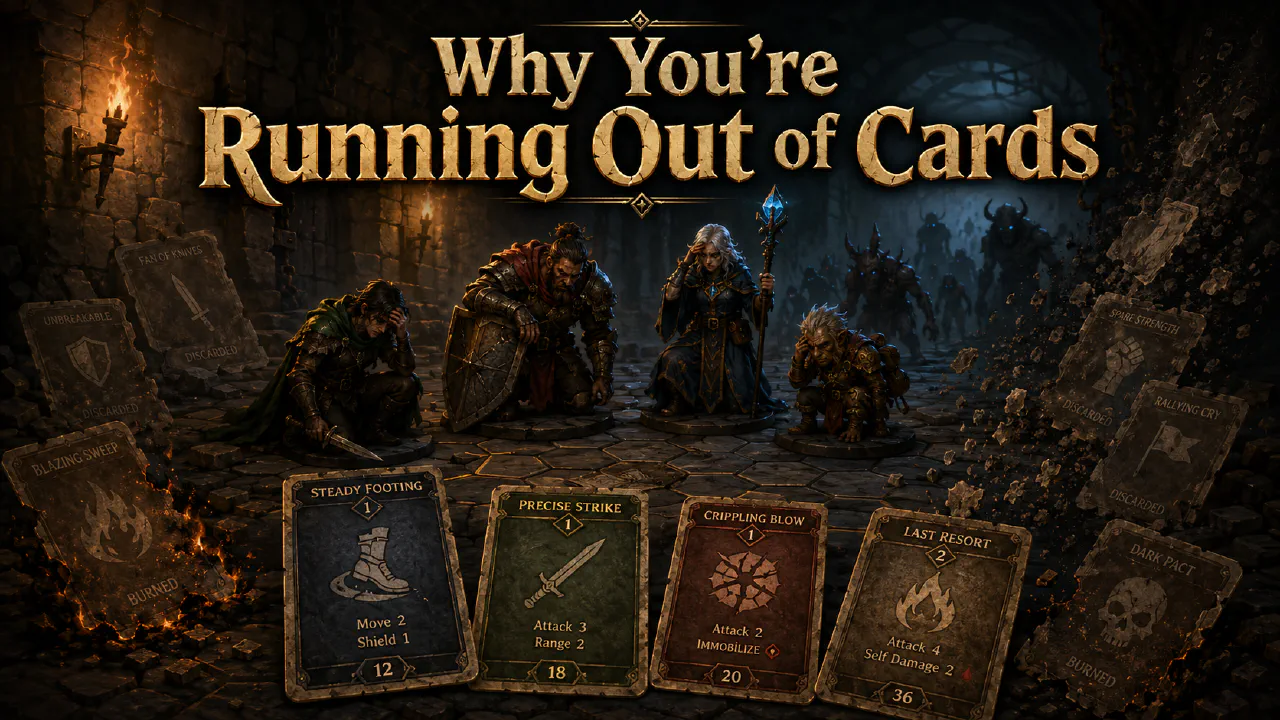
Running Out of Cards in Gloomhaven? Exhaustion and Card Management
Learn why you exhaust in Gloomhaven and Jaws of the Lion, how early loss cards reduce your turns, and how to finish scenarios with better card management.
Split-Party Scenarios: Stay Alive While Divided
How to survive split-party scenarios in Gloomhaven and Jaws of the Lion. Learn role assignment, pacing, initiative control, and regrouping tactics to avoid getting overwhelmed.
Why You’re Losing Scenarios Even When Playing ‘Correctly’
Explore common hidden reasons players lose Gloomhaven and Jaws of the Lion scenarios despite thinking they are playing correctly. Learn tactical, strategic, and game-mechanic blind spots that often determine losses.