
On this page
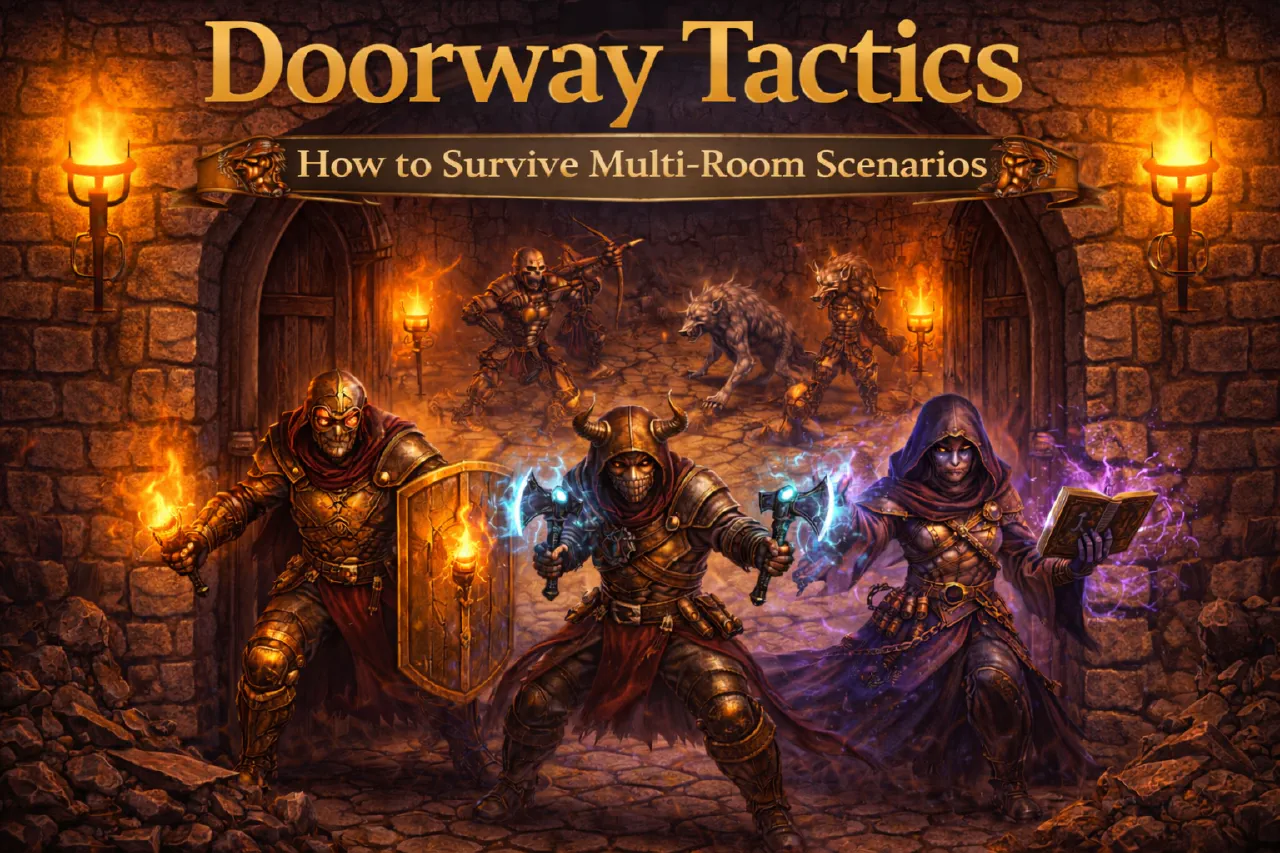
If your group often feels overwhelmed the moment a door opens, this article is for you. Doorway tactics are one of the single most important skills for surviving harder scenarios, and they apply across Gloomhaven, Jaws of the Lion, and Frosthaven.
This guide is spoiler-free and focuses on universal principles you can use in any scenario.
Why Doorways Are So Dangerous
Opening a door does three things at once:
- Reveals new enemies
- Reveals monster ability cards for new monster types
- Expands the battlefield
Most losses happen because parties treat door openings like normal movement — instead of recognizing them as major tempo events.
The goal of doorway tactics is simple:
Control how many enemies can reach you, and when.
Core Principle: Never Fight Two Rooms at Once
This is the #1 rule.
If enemies from two rooms can attack you in the same round, you are almost always losing value:
- You take more attacks
- You burn cards early
- Initiative becomes unpredictable
Exception: You are intentionally sprinting to an objective
The “Door Turn” — Why Timing Matters
Think of opening a door as its own phase of the scenario.
A good door turn:
- Happens when the current room is mostly cleared
- Occurs on a round with controlled initiative
- Uses minimal movement beyond the doorway
- Ends with your party holding position
A bad door turn:
- Happens mid-fight
- Is opened late in initiative
- Leaves multiple characters exposed
- Allows enemies to swarm immediately
Who Should Open the Door?
In most parties, the door opener should be:
- The tankiest character
- Someone with Shield, Retaliate, or high HP
- A character who can survive multiple attacks
Common good door openers:
- Red Guard
- Brute-style characters
- High-HP melee characters
Common bad door openers:
- Squishy supports
- Low-HP ranged characters
- Anyone who must stand still to function
Initiative Control at Doorways
The Ideal Door Opening Round
- Door opener goes early
- Everyone else goes late
Why this works:
- Early opener reveals the room
- Monsters don’t act yet
- Allies react with full information
- Enemies waste movement trying to reach you
This often causes:
- Ranged enemies to move instead of attack
- Melee enemies to bottleneck
- Monster turns to lose value immediately
The Worst Door Opening Pattern
- Door is opened late
- Monsters act immediately
- Enemies attack before you can respond
- You take unplanned damage
This is how parties get wiped.
Hold the Door — Don’t Rush In
A very common mistake is stepping fully into the room after opening the door.
Instead:
- Open the door
- Step one hex in (or not at all)
- Let enemies come to you
Why this is powerful:
- Limits how many enemies can attack
- Preserves choke points
- Maximizes Shield, Retaliate, and control effects
Doorways are natural funnels — use them.
Use the Doorway as a Choke Point
When enemies must pass through a doorway:
- Only a few can attack at once
- Melee enemies stack up uselessly
- Ranged enemies often reposition instead of attacking
This dramatically reduces incoming damage and makes:
- Healing more efficient
- Retaliation stronger
- Control effects more impactful
When It’s OK to Break Doorway Rules
Doorway tactics are strong — but not absolute.
It can be correct to push in when:
- The scenario is a race or escape
- Enemies spawn infinitely behind you
- You must reach an objective quickly
- The room contains few enemies but dangerous terrain
The key difference:
Breaking doorway discipline should be a conscious decision, not a mistake.
Common Doorway Mistakes (And Why They Hurt)
How Doorway Tactics Change Late-Game Difficulty
As scenarios scale up:
- Enemies hit harder
- Elite abilities become swingier
- Mistakes compound faster
Doorway discipline:
- Reduces randomness
- Stabilizes damage intake
- Gives your party time to adapt
Many “hard” scenarios become manageable once doorway play improves.
Final Takeaway
Doorways are not just transitions — they are control points.
If you remember nothing else, remember this:
Open doors deliberately, control initiative, and let enemies come to you.
Mastering doorway tactics will immediately improve your win rate across every multi-room scenario in Gloomhaven and Jaws of the Lion.
Next reads
Keep going with spoiler-light, practical guidance.
Why Positioning Matters More Than Damage
Learn why positioning is often more important than raw damage in Gloomhaven and Jaws of the Lion. A beginner-friendly guide to safer turns, better movement, and smarter scenario play.
Stop Healing So Much
Healing feels safe in Gloomhaven, but it can quietly cost you scenarios. Learn when healing is worth it, when it wastes tempo, and why preventing damage is usually stronger.
Running Out of Cards in Gloomhaven? Exhaustion and Card Management
Learn why you exhaust in Gloomhaven and Jaws of the Lion, how early loss cards reduce your turns, and how to finish scenarios with better card management.
How to Win Scenarios With Tight Time Limits
Practical strategies for beating time-limited scenarios in Gloomhaven and Jaws of the Lion. Learn pacing, card management, initiative control, and when to push instead of fight.
Split-Party Scenarios: Stay Alive While Divided
How to survive split-party scenarios in Gloomhaven and Jaws of the Lion. Learn role assignment, pacing, initiative control, and regrouping tactics to avoid getting overwhelmed.
Why You’re Losing Scenarios Even When Playing ‘Correctly’
Explore common hidden reasons players lose Gloomhaven and Jaws of the Lion scenarios despite thinking they are playing correctly. Learn tactical, strategic, and game-mechanic blind spots that often determine losses.