
On this page
You run out of cards when your remaining hand and discards can no longer support another turn or rest. Every rest loses a card, so even careful play has a limit. Early loss actions, losing cards to prevent damage, and rounds spent without advancing the objective all bring that limit closer.
To last longer, check where your cards are going, save early losses for actions that justify them, and plan the next room before your hand is empty. Keeping your HP high is useful, but it does not prevent card exhaustion.
Games covered: Original Gloomhaven (first edition) and Gloomhaven: Jaws of the Lion. The basic exhaustion and resting rules below apply to both. The Jaws tutorial uses smaller introductory hands; the ten-card example describes a full hand, not those tutorial hands.
The rules check: empty hand does not always mean exhaustion
At the start of a round, you need to either select two cards from your hand or declare a long rest. A long rest requires at least two discarded cards. If you can do neither, you exhaust, even with HP remaining.
A short rest happens at the end of a round, so it is not a rescue option you can choose after the next round has started. Both rest types lose one discard and recover the remaining discards. They do not normally recover cards already in the lost pile. See Short Rest vs Long Rest for the timing and procedures.
| At the start of a round | What you can do |
|---|---|
| Two or more cards in hand | Select two cards; you may instead long rest if eligible |
| Zero or one card in hand, two or more discards | Declare a long rest |
| Zero or one card in hand, zero or one discard | Exhaust from insufficient cards |
Cards in your active area are not in your hand or discard pile. A persistent effect can be valuable, but its card is unavailable for your next card selection while it stays active.
The original rulebook’s Exhaustion section, p. 28, and the Jaws Glossary, Exhaustion, p. 9 explain when a character must stop participating.
Worked example: one early loss can cost four later turns
Imagine a ten-card character, using only short rests and playing two cards on every turn. Compare two cases:
- No extra losses: every played card is discarded; only rests lose cards.
- One early loss: one of the cards played on turn 1 uses a loss action. After that, only rests lose cards.
Neither case uses card-recovery effects, loses cards to prevent damage, or keeps cards in the active area. These are idealized endurance counts, not promises about how long a real scenario should take.
| Point in the scenario | No extra losses | One loss on turn 1 |
|---|---|---|
| Normal turns before the first rest | 5 | 5 |
| Available cards after the first rest, including any held cards | 9 | 8 |
| Normal turns before the second rest | 4 | 4 |
| Normal turns across the whole scenario | 25 | 21 |
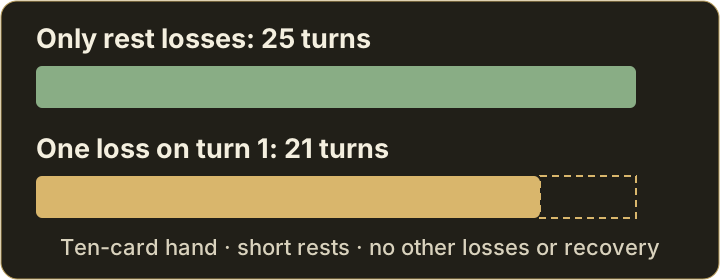
The early loss does not immediately remove four turns. Its cost accumulates as the smaller deck goes through later rests.
Without the extra loss, the number of turns between rests is 5 + 4 + 4 + 3 + 3 + 2 + 2 + 1 + 1 = 25. With the turn-1 loss, it is 5 + 4 + 3 + 3 + 2 + 2 + 1 + 1 = 21.
The first card cycle still gives you five turns because you played the lost card as part of a turn. The difference appears later. That is why a loss can feel inexpensive now but leave you short in the final room.
The decision is whether the loss saves enough time or danger to justify that cost. A powerful action that prevents several enemy attacks or completes an urgent objective can be worth it. A small damage increase against an enemy the party would already kill deserves more scrutiny.
Check which actions are actually losing cards
Selecting a card with a loss symbol does not automatically lose it. Check the action you perform.
Using a card for its basic Attack 2 top action or Move 2 bottom action discards it normally, even if the corresponding printed action has a loss symbol. Using a non-loss half also does not lose the card merely because the other half has a loss symbol. See the basic-action and loss clarification.
For a persistent loss effect, the card remains active while its effect lasts, then goes to the lost pile. Do not return it through an ordinary rest just because it has not reached that pile yet.
Before playing an early loss, identify its job: remove a threat before it acts, make an otherwise unreachable move, or keep the objective alive. If a basic action or the other half does enough, you may be able to keep the stronger action for later.
Damage prevention can spend your endurance quickly
When you suffer damage, you may negate that source of damage by losing one card from your hand or two cards from your discard pile. Cards selected for the round are not still in your hand. This rule can prevent immediate exhaustion, but repeated use shrinks later card cycles. See the Jaws Glossary, Negating Damage, p. 15.
Use it when necessary to stay in the scenario. If you need it repeatedly, review the turns leading up to the damage:
- Could you have ended outside an enemy’s attack range?
- Could initiative timing have let the enemy act before you approached?
- Could the party have removed one attacker instead of injuring several?
Our positioning guide and initiative guide explain ways to reduce those emergencies.
Spend rounds on the scenario’s actual goal
Even without extra losses, your cards support a limited number of active turns. Clearing an unnecessary enemy, making a separate trip for coins, or taking several rounds to regroup can use time you need later.
Read the victory condition first. In a kill-all scenario, every required enemy matters. In an escape or objective scenario, some enemies may only matter if they block progress or threaten the goal.
For example, after a room is nearly cleared, one character might finish the last enemy while another moves toward the door. If everyone waits in place, the party may need another full round just to reach the next room. Coordinate the transition rather than opening a door before teammates are ready; see Doorway Tactics.
Healing is also a decision about progress. Removing poison or wound, preventing exhaustion, or avoiding a later card loss can justify a heal. Healing safe characters while an objective stalls may not. The healing guide explores that trade-off.
Rest timing helps, but it does not restore lost cards
Rest when the party can support the choice. A long rest can add a recovery round, heal, refresh spent items, and protect an important card from a random loss. It does not give you extra normal two-card turns by itself, and a timed objective keeps advancing while you rest.
Resting early also has a cost: you lose a discard after using fewer of the cards you could have played before that rest. Sometimes that is worthwhile to recover a crucial card; repeatedly doing it without a reason shortens your endurance.
With one card in hand and several discards, you are not necessarily in trouble. Plan the rest before the end-of-round short-rest window passes, using the rest comparison.
A checklist for your next scenario
- Confirm the objective. Decide what must happen to win and which enemies actually obstruct it.
- Check card destinations. Separate hand, discards, active effects, and losses; use basic actions when they do the job.
- Give each early loss a purpose. Identify what it saves or enables before spending it.
- Plan one round ahead. Consider your remaining hand, rest window, and position before opening a door.
- Review repeated emergency losses. If damage keeps costing cards, change how the party approaches enemies.
After a failed attempt, distinguish too many rounds from too many extra losses. If you lost only the usual rest cards, work on scenario pacing. If several cards went to losses early, examine those decisions and the attacks that forced them.
Rules references
- Original Gloomhaven: Rulebook p. 17, Resting; p. 18, basic actions; pp. 25–26, active bonuses; p. 28, Character Damage and Exhaustion. The linked searchable transcription reproduces the publisher’s rulebook.
- Jaws of the Lion: Glossary pp. 9, 14–17, including Exhaustion, Lost, Negating Damage, Persistent Ability, and Rest. The link is a hosted copy of the publisher’s glossary.
Next reads
Keep going with spoiler-light, practical guidance.
Why Positioning Matters More Than Damage
Learn why positioning is often more important than raw damage in Gloomhaven and Jaws of the Lion. A beginner-friendly guide to safer turns, better movement, and smarter scenario play.
Stop Healing So Much
Healing feels safe in Gloomhaven, but it can quietly cost you scenarios. Learn when healing is worth it, when it wastes tempo, and why preventing damage is usually stronger.
How to Win Scenarios With Tight Time Limits
Practical strategies for beating time-limited scenarios in Gloomhaven and Jaws of the Lion. Learn pacing, card management, initiative control, and when to push instead of fight.
Split-Party Scenarios: Stay Alive While Divided
How to survive split-party scenarios in Gloomhaven and Jaws of the Lion. Learn role assignment, pacing, initiative control, and regrouping tactics to avoid getting overwhelmed.
Why You’re Losing Scenarios Even When Playing ‘Correctly’
Explore common hidden reasons players lose Gloomhaven and Jaws of the Lion scenarios despite thinking they are playing correctly. Learn tactical, strategic, and game-mechanic blind spots that often determine losses.