
On this page
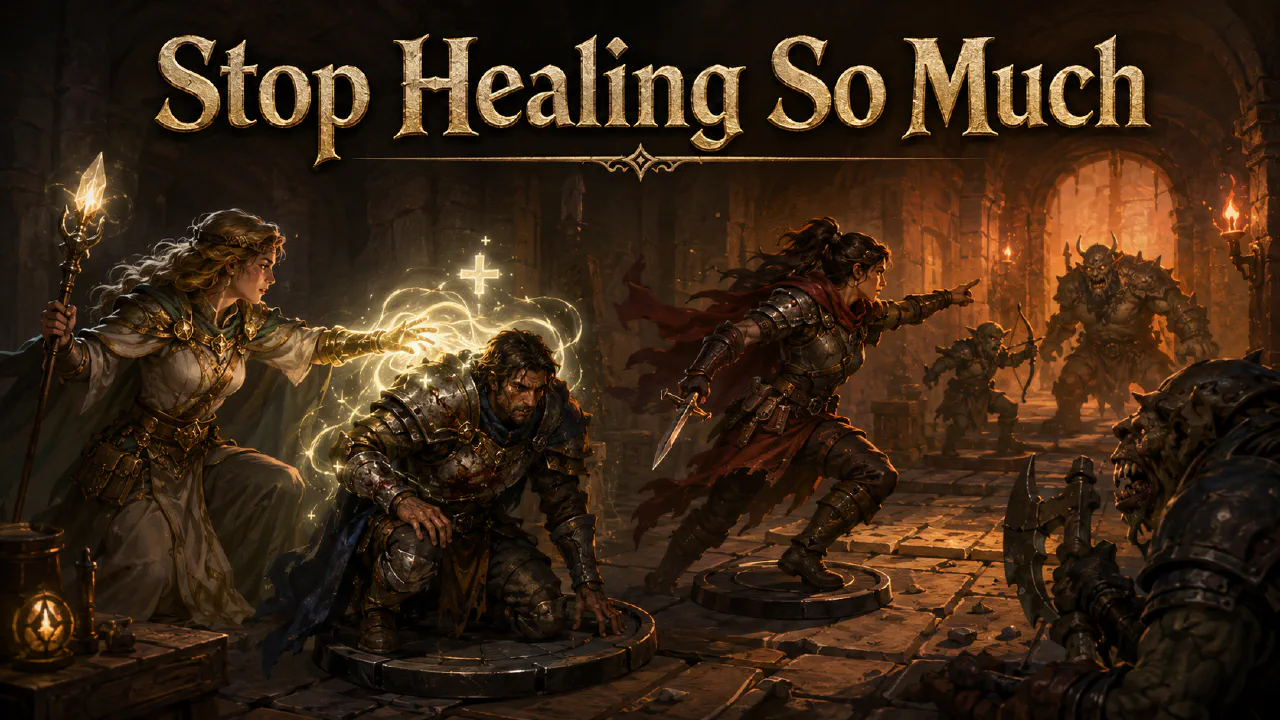
Healing feels like the responsible choice in Gloomhaven.
Someone is hurt. You have a heal card. The safe thing seems obvious:
Heal now, survive longer, win later.
Sometimes that is exactly right.
But many new players heal far too often — and it quietly costs them scenarios.
Gloomhaven is not a game where you win by keeping everyone at full health. You win by completing the scenario before your cards, hit points, and positioning collapse. Healing helps when it supports that goal. It hurts when it replaces progress.
This article explains why healing can be a trap, when it is actually worth doing, and what to do instead.
Healing Feels Safe, But It Has a Cost
A healing action usually costs you something important.
It may cost:
- an attack
- movement toward the objective
- a control effect
- a better position
- a chance to kill an enemy before it attacks
- a turn of scenario progress
That does not mean healing is bad.
It means healing is not free.
Every time you heal, ask:
What am I not doing this turn because I chose to heal?
If the answer is “I’m not killing the enemy that will attack us again,” healing may only delay the problem.
The Best Healing Is Damage That Never Happens
In Gloomhaven, preventing damage is usually stronger than repairing damage afterward.
You can prevent damage by:
- killing an enemy before it attacks
- stunning, disarming, immobilizing, or muddling a threat
- moving out of range
- using initiative to avoid a bad enemy turn
- forcing monsters through a doorway or choke point
- blocking line of sight
- letting slow enemies fall behind
A heal fixes damage after the enemy has already succeeded.
A good tactical play may stop that enemy from succeeding at all.
For example, healing 3 damage feels useful. But killing a monster that would have attacked for 4 is often better. Disarming that monster may be better still if it saves multiple characters from damage.
Healing Does Not Advance Most Scenario Objectives
Most scenarios are not won by having the healthiest party.
They are won by:
- killing required enemies
- reaching locations
- surviving long enough
- defending objectives
- interacting with scenario elements
- escaping before exhaustion
Healing can support those goals, but it usually does not directly advance them.
This is why over-healing is so dangerous. You may feel like you are stabilizing, but the scenario clock is still ticking.
Your cards are running out.
Enemies may still be spawning.
The next room is still unopened.
The objective is still waiting.
A party at full health can still lose if it gets there too late.
The Heal Loop Trap
New players often fall into this pattern:
- Take damage from enemies.
- Spend a turn healing.
- Enemies live longer because you did not attack or reposition.
- The enemies attack again.
- You need to heal again.
This is the heal loop.
It feels safe, but it usually means the party is losing tempo.
Instead of asking, “How do we recover from this damage?” ask:
Why are we taking this damage repeatedly?
The answer is often:
- enemies are staying alive too long
- someone is standing in too many attack ranges
- the party is fighting in an open area
- initiative choices are exposing characters
- you are not focusing threats efficiently
Fixing those problems is usually better than healing through them.
When Healing Is Actually Worth It
Healing is not bad. It is just situational.
Healing is usually worth it when it does one of the following.
It Prevents Exhaustion
If a character is close to dropping and healing keeps them in the scenario, heal them.
That is not comfort healing. That is survival.
This is especially important if that character:
- is holding a doorway
- needs to complete an objective
- still has important cards left
- would otherwise have to lose cards to prevent damage
A heal that prevents exhaustion can absolutely win a scenario.
It Prevents a Lost Card
Sometimes healing is worth it because it avoids a future forced card loss.
If a character is about to take a large hit, healing them beforehand may prevent them from needing to lose a card to stay alive.
That matters because lost cards shorten the scenario.
A heal that preserves card stamina can be very strong.
It Clears a Dangerous Condition
Healing removes certain negative conditions in addition to restoring hit points.
This can be extremely valuable when dealing with effects like Poison or Wound.
For example:
- Healing a poisoned character may restore no hit points, but removing Poison can make future healing work again.
- Healing a wounded character can stop repeated damage from draining them every round.
In these cases, the condition removal may be more important than the number of hit points restored.
It Keeps the Frontline Working
Some characters are supposed to absorb pressure.
If your tank or frontline character is holding a critical position, healing may be the action that lets the whole party keep its formation.
This is especially true in:
- defend scenarios
- doorway fights
- swarm scenarios
- rooms with dangerous melee enemies
But even then, healing should support the larger plan. If the frontline is taking endless damage while the rest of the party makes no progress, the problem is not healing — it is the plan.
It Happens While Doing Something Else
The best heals are often attached to useful turns.
Healing is much better when it comes with:
- movement
- an attack
- a useful bottom action
- a positioning improvement
- a non-loss support effect
A heal that advances the turn in another way is far easier to justify than a full turn spent only patching up damage.
If you can heal while still moving toward the objective or setting up the next round, that is usually a strong use of the action.
When Healing Is Usually a Mistake
Healing is usually weak when it is only making the party feel safer without changing the outcome of the scenario.
Watch out for these situations.
Healing Someone Who Is Not in Real Danger
A character missing a few hit points does not automatically need healing.
Ask:
- Are they likely to be attacked soon?
- Can they move out of danger?
- Can we kill or disable the threat instead?
- Are they close to exhaustion?
If the answer is no, healing may not matter yet.
Gloomhaven characters are allowed to be injured. You do not need to keep everyone topped off.
Healing Instead of Killing a Threat
If an enemy is about to attack again, healing may only delay the damage.
Sometimes the better defensive action is an offensive one.
For example:
- Heal 3 now, then take another 4 damage later.
- Or kill the monster now and prevent the next attack entirely.
The second option is often stronger, even though it does not look like “defense.”
Healing Instead of Moving
This is a common way to lose time-limited, escape, and objective-based scenarios.
You stop to heal because it feels safe. But now you are one round farther from the goal.
Sometimes it is better to move while injured than heal while standing still.
A wounded character near the objective is often more useful than a healthy character who is too far away.
Healing Before You Know What Monsters Are Doing
Healing early in the round can be risky if you do not yet know whether enemies will attack, move, or do something unexpected.
Sometimes you heal someone who would not have been hit anyway.
Other times, you heal before a much larger damage spike lands, and the heal barely matters.
Pay attention to initiative and monster ability cards. Healing is strongest when it is timed around real danger, not imagined danger.
Healing Because You Have Nothing Better to Do
This sounds harmless, but it can reveal a bigger issue.
If your turn is “I guess I’ll heal,” ask whether your character is:
- too far from the fight
- poorly positioned
- holding the wrong cards
- failing to support the objective
- acting at the wrong initiative
A low-value heal is often a symptom of a low-value turn.
Health Is a Resource, Too
One of the biggest beginner breakthroughs is realizing that hit points are meant to be spent.
You do not want to take unnecessary damage. But you also do not need to avoid every hit.
Taking 2 or 3 damage may be worth it if it lets you:
- kill a dangerous enemy
- reach an objective
- open a door at the right time
- avoid spending a lost card
- save a full round of movement
The goal is not to end the scenario unharmed.
The goal is to end the scenario successfully.
How to Heal Better
If your party feels like it is healing constantly, try these habits.
Heal With a Purpose
Before healing, identify the reason.
Good reasons:
- “This prevents exhaustion.”
- “This clears Wound.”
- “This keeps our tank in the doorway.”
- “This prevents a likely lost card.”
- “This lets us push the objective next round.”
Weak reasons:
- “They are missing health.”
- “I don’t know what else to do.”
- “It feels safer.”
- “I want everyone topped off.”
Purposeful healing wins games. Habit healing wastes turns.
Pair Healing With Progress
Whenever possible, heal while still advancing the scenario.
That might mean:
- heal and move
- heal after opening distance from enemies
- heal while preparing for the next room
- heal as part of a larger support turn
Avoid full-stop healing turns unless the situation truly demands it.
Prevent the Next Attack
After healing someone, ask:
Are they just going to get hit again?
If yes, you need a follow-up plan.
That plan might be:
- kill the attacker
- move the wounded character away
- apply control
- block the path
- change initiative next round
Healing without preventing the next hit is often just buying a very small amount of time.
Let Some Damage Sit
You do not need to heal every wound immediately.
It is often fine to let a character stay partially injured if:
- they are not in danger
- the party is progressing
- the heal would cost a strong action
- the next room is not open yet
- another character can cover them later
Patience is part of good healing.
The Best Support Is Not Always Healing
Support can mean many things.
A support character may help more by:
- granting an attack
- applying Curse
- applying Disarm or Stun
- moving an ally
- manipulating enemy positioning
- creating advantage on a key attack
- helping the party finish a room faster
Healing is only one kind of support.
In Gloomhaven, the strongest support often prevents problems instead of repairing them.
Final Takeaway
You should heal in Gloomhaven.
But you should not heal automatically.
Healing is strongest when it:
- prevents exhaustion
- saves cards
- clears dangerous conditions
- supports a critical position
- enables objective progress
Healing is weakest when it:
- replaces movement
- delays killing threats
- tops off safe characters
- makes you feel comfortable without changing the board
If you remember one thing, remember this:
Healing is not the goal. Winning the scenario is the goal.
Sometimes healing helps you win.
Sometimes the best heal is making sure the monster never gets another attack.
Next reads
Keep going with spoiler-light, practical guidance.
Why Positioning Matters More Than Damage
Learn why positioning is often more important than raw damage in Gloomhaven and Jaws of the Lion. A beginner-friendly guide to safer turns, better movement, and smarter scenario play.
Running Out of Cards in Gloomhaven? Exhaustion and Card Management
Learn why you exhaust in Gloomhaven and Jaws of the Lion, how early loss cards reduce your turns, and how to finish scenarios with better card management.
How to Win Scenarios With Tight Time Limits
Practical strategies for beating time-limited scenarios in Gloomhaven and Jaws of the Lion. Learn pacing, card management, initiative control, and when to push instead of fight.
Split-Party Scenarios: Stay Alive While Divided
How to survive split-party scenarios in Gloomhaven and Jaws of the Lion. Learn role assignment, pacing, initiative control, and regrouping tactics to avoid getting overwhelmed.
Why You’re Losing Scenarios Even When Playing ‘Correctly’
Explore common hidden reasons players lose Gloomhaven and Jaws of the Lion scenarios despite thinking they are playing correctly. Learn tactical, strategic, and game-mechanic blind spots that often determine losses.