
On this page
Game and scope: Jaws of the Lion with its original components. This guide covers starting-class mechanics and practical decisions, without later-level unlocks or a level-by-level build. During scenarios 1–5, follow the Learn to Play Guide as it introduces cards and rules.
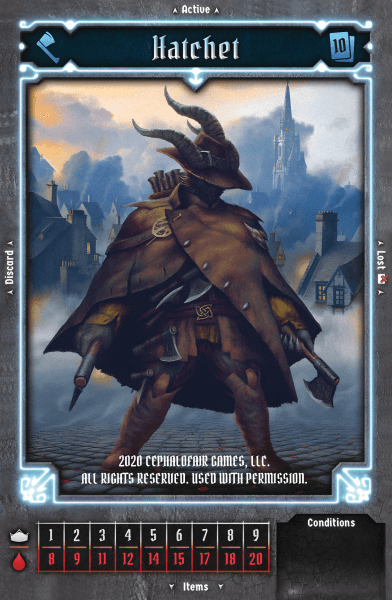
Hatchet specializes in ranged damage. The full hand limit is 10, with 8 HP at level 1. A useful plan includes both a target and a route to recover the Favorite token.
How The Favorite works
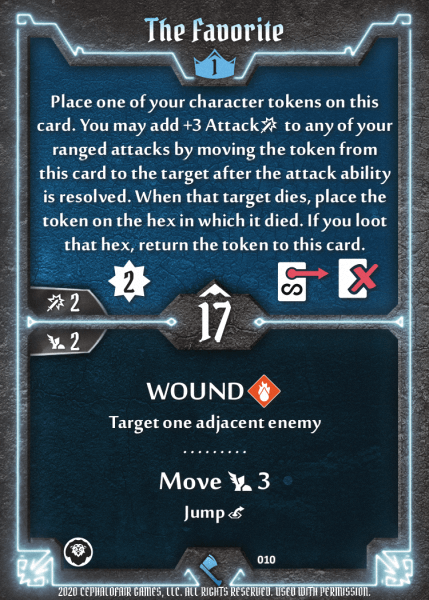
The top of level 1 The Favorite establishes a persistent loss effect and places a character token on the card. While the token is there, you may give one ranged attack +3 Attack, committing the token to that target after the attack ability resolves. The bonus applies to one attack, not every target of a multi-target ability. Decide on the attack bonus before drawing its modifier.
When that target dies, place the token on its death hex. Looting that hex returns the token to The Favorite card, allowing another use of the bonus. The effect does not automatically return the token after every attack or kill. Moving the token does not itself create another attack, and it does not require losing The Favorite card again.
The Favorite stays in your active area while its persistent effect is in use. It is unavailable to rests; when removed, it goes to the lost pile. Its ongoing bonus can justify that endurance cost, but assess how many useful attacks remain.
Retrieval gives you another recovery option
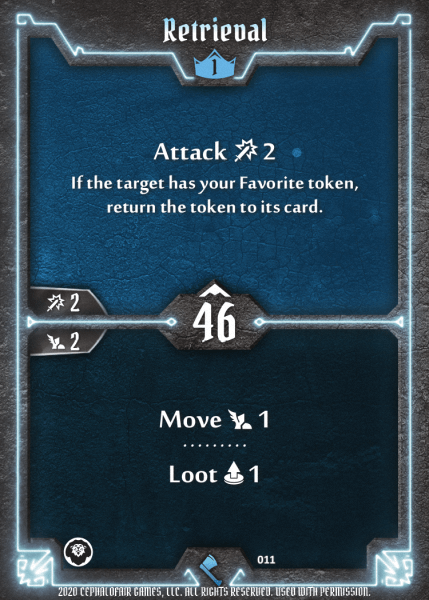
The top of level 1 Retrieval is a melee Attack 2. If its target has your Favorite token, it returns that token to the card. Do not turn this into a ranged attack by assuming all Hatchet attacks have range.
Retrieval’s bottom is Move 1 followed by Loot 1. That Loot can help collect a Favorite token from a death hex. Choose a top from one selected card and a bottom from the other; you cannot perform both Retrieval halves on the same normal turn.
Pick safe firing positions
A ranged attack against an adjacent enemy has disadvantage unless canceled by advantage. Walls can block sight; allies and ordinary obstacles do not provide cover or a defensive modifier. Check the monster’s movement and range before assuming that distance alone protects you.
Coordinate kills without chasing the token into a dangerous room. Sometimes another required target or the scenario objective matters more than immediately recovering it. For the collection timing, see looting.
A useful first full-hand plan
Pick one important target and identify a hex from which you can attack it without adjacency disadvantage. Then look at the return route: if that target receives the Favorite and dies, can you recover the token while moving toward the next task?
You do not have to retrieve it immediately at any cost. If recovering it would expose you to several attacks, another useful attack or a safer move can be better. Do not treat the token as an objective that overrides the actual scenario goal.
Example: preparing the next shot
Suppose the Favorite token is on a defeated enemy’s hex one movement step away, with a second enemy farther beyond it. Retrieval’s bottom can move you onto the token and then perform Loot 1. If your other selected card supplies a legal ranged attack, you can perform that top afterward and use the recovered Favorite again. Check range and sight from your new hex before committing.
This is a sequence of two complete actions. You cannot interrupt a top attack ability with Retrieval’s bottom to collect the token halfway through that ability.
Cards, rests, and party cooperation
The full ten-card hand is your limit for a scenario, not every card you own. Keep enough non-loss movement and attacks to continue after a rest. If you activate The Favorite, its card stays active instead of joining the discards that your rest recovers.
A teammate can finish the enemy carrying your token; the token still goes to that enemy’s death hex. Coordinate the kill and the recovery rather than assuming Hatchet must personally make every finishing blow.
For a first two-character party, Red Guard is a natural partner to consider, but the other pairs have useful roles too. Compare them in Jaws two-character parties. For a ranged attack made beside an enemy, use the advantage and disadvantage guide rather than assuming every ranged attack is safe at close quarters.
Sources
The publisher’s Jaws Glossary, particularly Ability Card, Attack, Advantage and Disadvantage, Loot, Persistent, and Rest; and the following reproductions of the actual game components (hosted by Worldhaven):
Next reads
Keep going with spoiler-light, practical guidance.
Best Two-Character Parties in Jaws of the Lion
Compare all six Jaws of the Lion character pairings, with beginner recommendations, party strengths, positioning advice, and pitfalls for two players or solo play.
Jaws of the Lion Voidwarden Guide: Granted Attacks and Starting Tactics
A starting-class Voidwarden guide for Jaws of the Lion: granted attacks, Master Influence, modifier decks, and positioning.
Jaws of the Lion Red Guard Guide: Shield Spikes and Starting Tactics
A starting-class Red Guard guide for Jaws of the Lion: Shield Spikes, Swift Strength, focus, and defensive timing.
Jaws of the Lion Demolitionist Guide: Starting Cards and Positioning
A starting-class Demolitionist guide for Jaws of the Lion: melee positioning, obstacles, direct damage, and card endurance.