
On this page
Game and scope: Jaws of the Lion with its original components. This guide covers starting-class mechanics and practical decisions, without later-level unlocks or a level-by-level build. During scenarios 1–5, follow the Learn to Play Guide as it introduces cards and rules.
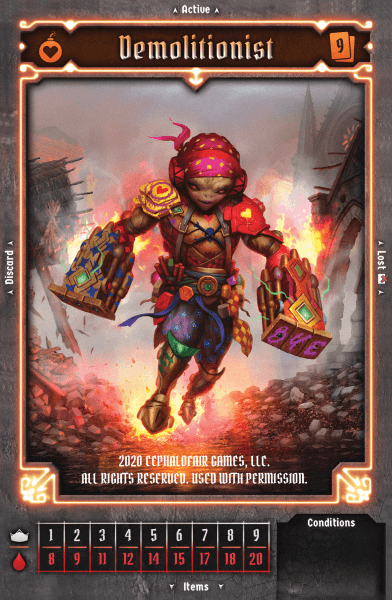
The Demolitionist is a close-range attacker who can exploit walls and destroy obstacles. The full hand limit is 9, with 8 HP at level 1. Plan movement carefully: an obstacle bonus is useful only when you can reach the right hex and survive there.
Attacks and direct damage work differently
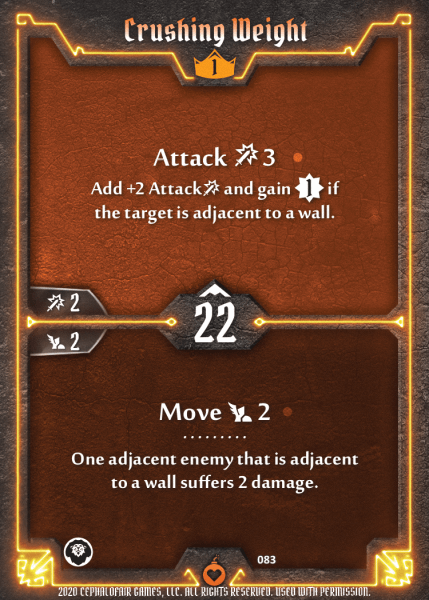
Crushing Weight, a level 1 card, illustrates the distinction. Its top is a melee Attack 3, with +2 Attack and 1 experience when the target is adjacent to a wall. Draw an attack modifier and apply Shield normally. A wall is not the same thing as an obstacle.
Its bottom gives Move 2, then makes one adjacent enemy that is also adjacent to a wall suffer 2 damage. That second effect is direct damage: no attack modifier is drawn and Shield does not reduce it. You cannot use both halves of Crushing Weight on the same normal turn.
There is no general rule that Demolitionist attacks bypass Shield. Read whether the effect actually says Attack or says a figure suffers damage.
Destroy obstacles for a purpose
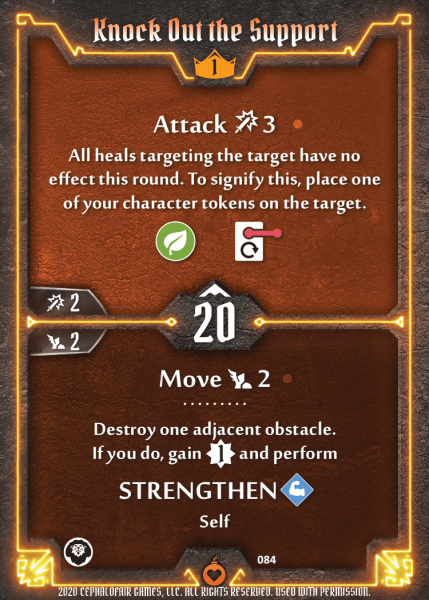
The bottom of level 1 Knock Out the Support gives Move 2, then lets you destroy one adjacent obstacle. Destroying it awards 1 experience and Strengthen, Self. Without an eligible obstacle to destroy, you do not receive those conditional benefits.
Strengthen gained during your turn lasts through your next full turn. This can improve an attack later in the current turn as well as attacks on the following turn. You cannot interrupt that bottom action with your other card’s top action.
Destroying an obstacle may open movement routes for enemies as well as allies. Ordinary obstacles do not block sight. Check the scenario’s restrictions before destroying a feature, and do not treat an objective as an ordinary obstacle.
Choose a sustainable turn
With nine cards, unnecessary early losses are costly. Keep useful movement available and use basic actions when a printed effect has no useful target. The basic action does not grant the printed half’s extra damage, experience, conditions, or elements.
Red Guard may help manage pressure, but standing behind an ally does not guarantee safety. Voidwarden’s Curse effects can reduce future enemy attack damage; they do not reduce enemy HP or Shield. Apply monster focus to the actual board before committing to a melee position.
A useful first full-hand plan
Start with a legal melee target, an attacking hex you can reach, and a useful destination for the end of the turn. Only then ask whether an obstacle or wall bonus improves that plan. Chasing a terrain bonus across the room can cost more than making an ordinary productive attack nearby.
Example: Strengthen before a top attack
If an eligible obstacle is beside a hex you can reach, perform Knock Out the Support’s bottom first. Resolve its Move, destroy the obstacle, and receive the conditional experience and Strengthen. You can then perform the top attack of your other selected card with advantage, provided its target is legal from where you stopped.
The obstacle destruction belongs to the bottom action. You cannot use the top of Knock Out the Support as the second action on that same normal turn. If the obstacle is a scenario objective or a feature that cannot be destroyed, choose a different plan.
Budget the nine-card hand
A nine-card hand makes extra losses worth examining carefully. Losing one card from hand to prevent damage may save you now, but it also reduces later card cycles. Pick positions that limit incoming attacks and avoid using a loss action merely because a terrain bonus makes the turn look impressive.
A long rest can offer recovery when the party has a safe window; a short rest keeps a normal turn available next round. Neither recovers lost cards. Keep a useful movement option after deciding what to lose so you can still reach the next required enemy or objective.
If you are pairing Demolitionist with another close-range character, agree on different destination hexes. Allies do not block sight and you can normally move through them, but you cannot finish movement on their hex. Compare the options in Jaws two-character parties and use card endurance to review repeated early exhaustion.
Sources
The publisher’s Jaws Glossary, particularly Attack, Destroy Obstacle, Strengthen, Suffer Damage, and Rest; and the following reproductions of the actual game components (hosted by Worldhaven):
Next reads
Keep going with spoiler-light, practical guidance.
Best Two-Character Parties in Jaws of the Lion
Compare all six Jaws of the Lion character pairings, with beginner recommendations, party strengths, positioning advice, and pitfalls for two players or solo play.
Jaws of the Lion Voidwarden Guide: Granted Attacks and Starting Tactics
A starting-class Voidwarden guide for Jaws of the Lion: granted attacks, Master Influence, modifier decks, and positioning.
Jaws of the Lion Red Guard Guide: Shield Spikes and Starting Tactics
A starting-class Red Guard guide for Jaws of the Lion: Shield Spikes, Swift Strength, focus, and defensive timing.
Jaws of the Lion Hatchet Guide: The Favorite and Starting Tactics
A starting-class Hatchet guide for Jaws of the Lion: The Favorite, Retrieval, ranged attacks, and safe positioning.